Showing posts with label Amphibians. Show all posts

Monday, October 22, 2012

Oh, Caecilian, You're Breaking my Heart

Within amphibians, there are the frogs and toads (order Anura; it means tailless), which can be considered too cute to include on this blog and there are the salamanders and newts (order Caudata or Urodela, both meaning with a tail), which I’ve already posted about one1. There is a third order of amphibians, of which most people have not heardof. The scientific name for the order is either Gymnophiona (naked snake) or Apoda (footless), both of which are stunning endorsements for the inclusion of a caecilian on this blog.

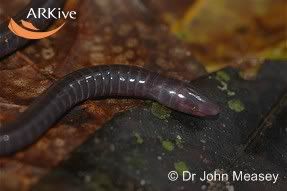
Image from ARKive

The Sagala Caecilian (Boulengerula niedeni) is a species that was first described in 2005. Its name comes from the hill it inhabits (Sagala Hill in southern Kenya). Since they’re such a newly discovered species, there’s a lot that still isn’t known about them, but scientists are pretty sure that their range is about 30 sq. km, which is smaller than Manhattan Island. Right there, with that small of a range, they become listed as Critically Endangered. Along with its already minimal range, large-scale farming disrupts streamside habitats, where they make their home, and introduces pollutants.

I’m having problems finding specifics about the Sagala caecilian, such as what it eats (probably small invertebrates) and specific reproductive history, though caecilians are the only order of amphibians that perform internal fertilization. In fact, the discerning feature of this amphibian, used to describe it as a new species, is its oddly shaped phallus.

On a different note, I have received my Official EUTshirt, and I am pleased with the quality. The concept of a cute lamprey stuck with me since I wrote about it. I asked friends and family if the idea of a line of cute Endangered Ugly Things t-shirts went against everything EUT stood for, and they said, “Maybe.” Well, they’re up and buyable anyway. Enjoy, and I’m up for any suggestions of other EUTs, since I’m having slight problems finding good ones.

1Possibly more to come, ‘cause if you thought the hellbender was big and ugly, there are some bigger, uglier ones out there.

Sunday, September 2, 2012

Like a Salamander Outta Hell

There has to be a story behind the eastern hellbender's name. It sounds like Dante on a drug trip, a motorcycle gang, or a punk metal band1 (the Ozark Hellbenders would perform cover songs heavily involving banjos). If anyone has the actual etymology behind the name, I'd be glad to hear it.

Despite having an ugly sounding name, the eastern hellbender, Cryptobranchus alleganiensis,Image from Ohio Department of Natural Resources is, in fact, not pretty. As an adult, they can achieve lengths of 11 to 20 inches. Folds of skin hang from their sides, through which they breathe. The hellbenders have lungs, but those are used only for buoyancy. Their heads are flat, with tiny, beady eyes. Their habitat exists under rocks and debris in clear, fast-moving streams.

These giant salamanders hunt crayfish, small fish, and large insects, searching mainly using lateral lines and then sucking in prey, a method not shared by any other adult salamander. Also seperating them from other salamanders is the fact that the hellbender practices external fertilization, where the female will drop the eggs and then allow the male to fertilize them. After this, the male will guard the eggs for two to three months until they hatch.

Hellbenders are endangered in Ohio, Maryland, Illinois, and Indiana, threatened in Alabama, and a species of concern in New York. Pollution is a major problem facing eastern hellbenders, and for that matter, many amphibians. This is due to their ability to breathe through their skin. Any chemical with a higher concentration in the water than their body is drawn in, be it oxygen, nitrogen, or agricultural runoff. Damming rivers cause silt to clog the hellbender's nesting site (remember the lungfish?). The bad rap that the hellbender gets also doesn't help, as there are many legends of the salamanders sliming fishers' nets or poisoning river water. Photos of herpetologists, gloveless, holding it, might help dispel these myths. So if you happen to be creeking in the eastern Midwest (or western East), and see a gigantic salamander, consider yourself lucky to be in the presence of the largest salamander around.

1They are a band! That's what I get for looking too far on the internet for hellbender research. Though, they look more indie than punk metal.

Wednesday, July 23, 2008

I Want my Baby Back

I apologize for the unintentional hiatus last month, but I start as a Master’s student next month, and preparations for such have gotten in the way of blogging. As it sounds like my workload will increase massively once school actually starts, don’t be surprised if Endangered Ugly Things continues on a monthly schedule for a while. I hate to say it, but in a fight between my blog and my education, my education wins out (barely).

Two weeks ago, both my girlfriend and my aunt sent me a link to MSNBC’s article on the “Top 10 Oddballs of the Animal World,” highlighting what they consider the weirdest looking animals out there. I hate to say, I could probably give some of those a run for their money1. It did point me back to EDGE’s amphibian list with a burrowing frog similar to the one I wrote about in May. I was worried about featuring another amphibian so soon (Ha!), but the Conservation Issue of The Year is the amphibian decline, so maybe two frog posts are justified. That, and this one deserves it.
Image from EDGE


The Myer’s Surinam Toad (Pipa myersi) belongs to a genus of frogs whose looks never fail to gather attention. As (according to EDGE) one naturalist put it:

"…looking – as all pipa toads look in repose – as though she had been dead for some weeks and was already partially decomposed."
A lovely image, though probably quite helpful in camouflaging themselves among the leaves within the Panamanian swamps they call home.

As swamps are not exactly known for their clarity, Surinam Toads have reduced eyes. They instead rely on fancy lobed fingers to feel out their prey, which they then grab or simply vacuum up—long sticky tongues simply won’t work underwater. Their prey preference appears to be what I like to call “any animal smaller than its head.”

What I find truly ugly about Surinam Toads is not the fact that they look like an unfortunate road-kill accident. It’s their baby rearing techniques. During mating, the couple maneuvers themselves such that about 100 eggs are spread along the sticky back of the female. These are gradually absorbed into the skin, where the young develop. Most Surinam Toad young go through their entire metamorphosis in their mother’s backs, emerging as tiny froglets (seen here2). The Myer’s Toad lets the kids out a little early, with the young emerging into the world as tadpoles.

If you’ll find the range map on the EDGE website, you’ll get an idea why Myer’s Surinam Toad is listed. If anything has a total range of less than 5000 sq. km, then it automatically gets on the endangered list. Habitat loss and fragmentation is probably aiding in their decline, though too few have been found to conduct a thorough population estimate. They are found in a reserve, so there may be hope to see baby tadpoles pushing their way out of their mother’s skin for years to come.


1Both my girlfriend and Phantom Midge have suggested I write about the Yeti Crab. However, so little is known about it that it isn’t listed anywhere, as well as the fact that there is only one photograph of it. I do think it should be adapted into plush form, though.
2It should be said that I find this creepy enough that I can’t watch the entire video. It looks like something from a horror film.

Thursday, May 22, 2008

Purple Haze

As a comment on my Copperbelly Watersnake post, Gargoyle Grins asked—very nicely—for a post on the Purple Burrowing Frog. I’m not sure when the comment was made, but I only saw it recently. I am more than happy to oblige a reader.

Image from EDGE, by S.D. BijuHaving only been formally described in 2003, there is a surprising amount of information known about the Purple Burrowing Frog (Nasikabatrachus sahyadrensis). So far, it has only been found in two small areas in Western India, where it spends most of its time buried underground.

There are two major reasons for its subterranean lifestyle: it’s moist underground, and that’s where the termites live. With minimal eyes1, the Purple Burrowing Frog relies on smell and touch to hunt. The pointy nose is useful for shoving through termite’s walls, and it has a tongue specially shaped for sucking up the little morsels. The Purple Burrowing Frog depends on termites for more than just a food source. The structures and tunnels built by the termites help aerate and moisten the soil. It is the only burrowing frog that feeds underground; all others simply hide in the dirt to avoid predators.

During the monsoon season, however, the frogs come out to breed. They make their way to nearby water sources, and begin the mating process. Due to similarities to other species, it’s probable that the male temporarily glues himself to the back of the female during amplexus. Since it was only discovered in 2003, there are still quite a few uncertainties about its lifecycle.

Our lavender friends are listed as endangered by the IUCN because the range it has been found in is so small, and the forests under which they dig are threatened by expanding cultivation. Much more needs to be learnt about this animal before conservation efforts can be put into place.

1Eye reduction happens a lot in underground animals.

Thursday, January 10, 2008

Babyface

When I started blogging, I told myself that I would have to keep a set deadline to make sure I kept it up. I would write one each weekend, and if I didn’t keep it up, I would almost certainly fall into the trap of procrastination. And here I am. I’m going to see if I can manage back into weekend-ly posts. Since this post is for last weekend, I’ll see if I can crank out another post by Sunday night. It’s getting harder than I expected to keep finding Endangered Ugly Things.
Image by Me


However, looking through IUCN’s list of amphibians, I never expected to see this guy. It’s the Axolotl (Ambystoma mexicanum), whose face appears on many “Strange Animals!”-type publications and programs1. They fall into that category due to the fact that they exhibit neoteny; that is, they never undergo metamorphoses like other amphibians, but retain their gills and dorsal fin for life. They are classified as mole salamanders (genus Ambystoma), which includes more everyday salamanders, such as the Eastern Tiger2.

If you think the name “Axolotl” is hard on the mouth, just wait, I’ve got a few doozies in the next paragraph.
The Axolotl likely gets its name from the Aztec words meaning “water-dog,” though some sources link it to the other Aztec god of the underworld, Xolotl, twin of Quetzalcoatl. With these clues (as well as the fact that its species name is mexicanum), it’s not hard to guess where these are generally found in the wild. Yes, it lives in central Mexico, and its historic range includes Lake Xochimilco and Lake Chalco, which hasn’t existed since before the Europeans showed up. Xochimilco (National Geographic pronunciation: SO-chee-MILL-koh) is now only a series of canals within the bounds of Mexico City. Understandably, Axolotl populations aren’t quite what they were when the Aztecs were using them as a daily meat source.

While pollution and habitat loss have thrown the wild Axolotls onto the Critically Endangered list, that isn’t to say that there aren’t many left. They breed in captivity wonderfully, and are used in many medical research labs to study their ability to regenerate limbs (wouldn’t that be convenient?).

The restoration of an ecological park has stabilized populations in the wild, and the introduction of the abundant captive bred individuals could bring these salamanders back from the brink. Also, a local university is working hard to save the local wildlife by increasing public awareness, and are using the Axolotl as their flagship species.

1I, personally, first came to know of their existence from a series called Zoobooks, where an Axolotl appeared on the cover of “Animal Wonders,” I believe.
2Neat fact: other Mole Salamander species have developed neoteny, which apparently frequently shows up where the water is low on predators and the surrounding land is dry.

Tuesday, August 7, 2007

Gut Feeling

Well, this week I had intended to write about the African Wart Frog, which is both incredibly cute and unbelievably ugly at the same time. Alas, I couldn’t find enough information about it, so I had to find another amphibian to take its place1. This one seemed to fit due to the fact that the WWF catalog that I mentioned in the last post was about “Wildlife Families.”
Image from American Museum of Natural History


This is an image of the Southern Gastric-Brooding Frog (Rheobatrachus silus). In 2002, they were moved from their status as endangered to extinct2. They looked like the typical grey and semi-aquatic frog, but their name gives away everything they were as parents. After mating, the female eats the eggs. Literally—there is no special mouth-pouch or anything like that; the eggs go straight into the stomach. This isn’t too much of a problem, since the female shuts down her digestive tract and does not eat anything from six to seven weeks. By this time, the frogs turn into froglets, and are ready to hop out of her mouth.

Living in Southern Australia, they were never found more than 12 feet from water. When they weren’t raising the kids, they’d eat all the insects they could catch. Their extinction is a mystery. The feral pigs that reside in the same habitat and the disruption of the water flow obviously couldn’t help, not to mention the problems that global climate change is causing all amphibians, what with more drought and higher UV levels. I suppose this makes the real mystery which one caused the most damage. If anyone was wondering why we care about the extinction of the Gastric-Brooding Frog, medical science will never know how the females turned off their stomach acid. Looks like I’ll have to stick with Nexium. Scientists have been on the lookout for them, but alas, none have been seen since 1981.

1All right, it didn’t have to be an amphibian, but I really do try to be all-inclusive when it comes to the major taxa. Since it’s been about two months since the last amphibian, I thought it was time for another one.
2I was really trying to avoid using the past tense to make this a blow at the end, but the thought of writing three paragraphs without any forms of “be” seemed too difficult.

Saturday, May 26, 2007

Reel Big Salamander

In the footnote for the Sagala Caecilian1, I mentioned some big, ugly salamanders. Both are endangered, and closely related to the Hellbender2, in the family Cryptobranchidae, and the three species are together known as the Giant Salamanders. I’ll skip over the second largest salamander (the Japanese Giant Salamander, Andrias japonicus, you can look up information on your own), and start talking about the largest salamander in the world.

Image from Giant Salamander Protection International


The Chinese Giant Salamander (Andrias davidianus) is visually quite a lot like the Hellbender: flattened body and head with tiny, beady eyes, and folds of skin hanging from its body through which it breathes. The major visual difference, which will cause no one to mistake the two, is that the Hellbender is about a foot long, while the Chinese Salamander gets up to about, oh, six feet or so. This picture is the only one I could find that uses a person for scale. I don’t think anyone will disagree with me writing about this animal here.

They live in the cold mountain streams of China. Since they’ve got no gills or lungs, these streams must be well oxygenated. They are nocturnal, and hunt with a quick sideways snap of their mouth. What they hunt seems only to be limited by what they can catch. The Giant Salamanders mate in late August, where, according to ARKive, “hundreds of individuals congregate at nest sites.” Take a look at the videos they’ve got3. Now imagine hundreds of those things in a single place, mating.

IUCN has a nice long list of why these stream-leviathans are endangered, such as wood plantations, mining, clear-cutting, hunting, and pollution. There’s a BBC article about the poaching problems. Conservation methods are coming into place, as they are a protected species. There’s even a Giant Salamander Protection International website, and protected areas in these mountains are starting to appear. While other people want to make sure there are tigers for their grandchildren to see, I want to make sure my grandchildren get the chance to see a six-foot long salamander. Heck, I want to see it.

1That was eight months ago! I’m impressed by how long I’ve kept this up, even if no one else is.
2I just got a job studying headwater streams in a nearby national park. My boss had a poster about Hellbender conservation in her office, and I asked if that meant they were local to the area. Alas, they are not. I was really hoping, too.
3I’m sure this is required viewing for CGI animators of Discovery Channel shows that involve prehistoric amphibians.

Sunday, January 28, 2007

Davey and Goliath

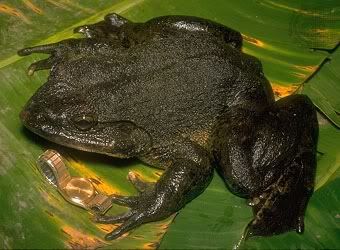
A while ago, I mentioned that frogs tend to be too cute to be mentioned here. I was mostly driven to this comment by the existence of the Golden Mantella, a tiny, big-eyed yellow frog, which happens to be critically endangered. My parents suggested that there might be, in fact, an ugly frog out there. I looked on the U.S. Endangered List and found something called a Goliath frog.

Goliath frog and watch--Image from Enyclopaedia Britannica

At 13 inches and 7 pounds, Conraua goliath lives up to its name. It is found in Equatorial Guinea and Cameroon. They tend to eat arthropods and fish, though they will eat anything smaller than their head that can be easily caught. ARKive has a picture of a Goliath frog eating... a Goliath frog. I didn’t find any indication of the frequency of cannibalism, though this article mentions it. It also talks about a 10-foot leap, but “it can only make three or four such bounds before giving in to exhaustion.” That is to say, they’ll be 30 feet away from you before they get tired.

The Goliath frogs, despite their large size, are difficult to find. The Cameroon Government allows the export of 300 individuals, though good hunters can find only a few dozen a year1. This does hint at the first cause of their endangerment: there’s a lot of meat on a 7 pound frog; they have been hunted for bush meat. They are exported for pet trade as well, but since they breed poorly in captivity, this collection does not help their numbers.

Scientists are trying to find more about their habits, and there was an extensive PIT-tagging project in 2004. However, legal aspects will have to come into play, since the Goliath frog is still unprotected.

1Though, for proper multiplication, it would be nice to have the number of good hunters around Cameroon.