Showing posts with label Freshwater. Show all posts

Monday, November 5, 2012

Like a Sturgeon

Last week, I showed my blog to my cousin, who just turned 20 (geez, we’re getting old). This was apparently a good move, since he sent me an e-mail earlier this week saying, “I think the lake sturgeon is endangered, but it’s kind of an older book.” A web search turns up threatened in New York, species of concern in Minnesota, and endangered in Ohio. And it’s plenty ugly, so good call there.

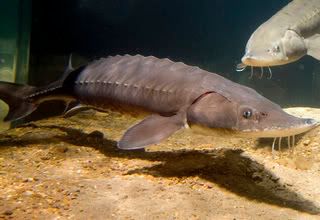
Image from Tennessee Aquarium

Think the 3-foot long lungfish with a 100-year lifespan isn’t enough? Howzabout the Lake Sturgeon (Acipenser fulvescens), right here in the Midwest, which, during its life of 150 years, can grow to 8 feet long. It has gigantic bony plates on its body, which grow smoother as it ages, because small spiky fish aren’t as digestible. The name “sturgeon” means “the stirrer” in various European languages (and, its scientific name means “reddish-yellow sturgeon” in Latin), which refers to its bottom-feeding habits. The “whiskers” (more technically barbules, which translates from Latin to… uh… whiskers) on their snout allow them to feel food items, such as crustaceans and small fish that are hiding under the substrate, which they suction up with their protruding mouth. Sound familiar?

As stated in the lungfish and tuatara posts, long life means one thing in the animal kingdom: slow to reproduce. Sturgeons take just as long to go through puberty as we do, reaching sexual maturity at 15 to 25 years of age, though they probably don’t have to worry about strange hair and cracking voices, what with being fish and all. Slow to reproduce means that this big fish is still getting over being used for meat, caviar, and isinglass (whatever that is). Pollution, damming, and the normal ol’ endangering factors still come into play.

Since this big bony fish has become protected in pretty much all of its range, the population has stabilized, even bumping it off the IUCN Redlist. It’s very much on its way to become one of those “Conservation Success Stories” like the bald eagle, but hopefully, when it’s pulled of the state endangered species lists, it gets some media attention too.

Sunday, September 30, 2012

It Sucks to be Me

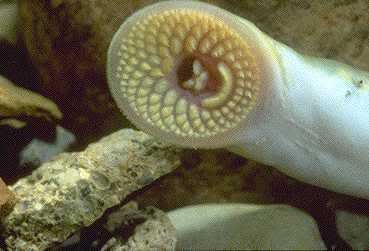
Blood-sucking. Slimy. Limbless. A face like an orbital sander mated with a shark. A species in concern in about 10 states. Sounds like we’ve got a candidate ripe for the honor of Endangered Ugly Thing, and EUT's new mascot. Meet the Ohio lamprey (Ichthyomyzon bdellium).

Image from Ohio DNR

The Ohio lamprey is a 2 foot long, eel-looking fish, which is native to streams and rivers in the eastern Midwest (or western East) states. In their two years as adults they parasitize fish by sucking onto other fish with its gaping maw (also known as an oral disc; lamprey don’t have jaws), where it proceeds to suck the host’s blood1.

Before the parasitic adult stage, baby lamprey (now isn’t that an adorable mental image?) spend four years buried in the riffles of small streams with their head poking out, filter feeding on algae and plankton. After this time, they develop eyes and an oral disc, make their way to a larger river, and find a suitable host. I’m not sure if how frequently they switch hosts, and it’s possible that the scientists don’t know either. After their first year, the lamprey disengage themselves from their hosts, and make their way back to the river that spawned them. Here, they will build a nest, often with the cooperation of other spawning lamprey, lay their eggs in the gravel, and die.

Quick quiz! What have all the aquatic vertebrates I’ve written about had a problem with?
Time’s up! If you guessed “Dams,” you’re correct! With the lamprey, dams stop them from being able to move to their feeding grounds as adults. The entrance of more silt in the streams, usually from runoff, gives the juveniles problems with filter feeding.

There are people working on fixing these problems, through land conservation and habitat monitoring. Determining good solutions for lamprey preservation requires that we learn a lot more about them. Sampling is hard due to their habits of being either buried in a stream or a fish for five-sixths of their life. Getting people interested in them is the first step toward saving them, so I’m trying to do my part.

1Can anybody think of a parasitic vertebrate that isn’t a lamprey? I know of the male anglerfish, but that hardly counts.

Sunday, September 16, 2012

I Wish They All Could be California Arthropods

This one falls into the category of ugly things that I came across while randomly looking through The List. I'm going to keep on the lookout for any others, but I'm running low on EUTs that I've heard of. If anyone has any suggestions, start sending 'em in

Image from Sacremento Fish and Wildlife ServicesLooking somewhat like a cross between a horseshoe crab and a shield bug, the vernal pool tadpole shrimp (Lepidurus packardi) gets the distinction of being the first invertebrate on Endangered Ugly Things. It will not be the last, as the diversity of invertebrates is staggering, and, with the exception of butterflies, they're pretty much all considered ugly.

Distantly related to triops and sea monkeys (actually brine shrimp), which you can buy at any decent science shop, the tadpole shrimp share their ability to breathe through their 35 or so phyllopoda (leaf-feet) which also act as paddles. They grow up to a whopping 2 inches in length, eat organic matter smaller than them, and get eaten by everything that normally eats benthic macroinvertebrates: other invertebrates, amphibians, fish, and some birds.

The vernal pool tadpole shrimp hangs its small, strangely shaped hat in ephemeral pools in the San Fransisco bay area that dry out every summer. It survives these dry spells by laying drought-resistant eggs, which will hatch once the pools fill up again.

There are no big suprises with why these are endangered. Habitat distruction is always a problem when your habitat is a big wet spot, and someone says, "Hey, this looks like the perfect place for a shopping mall." Suddenly, your big wet spot is under a ton and a half of concrete. Agricultural and urban runoff, overgrazing, and invasive plants are also having an effect on the tadpole shrimp. Hope exists for them in the form of programs to save wetlands, which are being put into effect all over the United States.

Sunday, September 2, 2012

Like a Salamander Outta Hell

There has to be a story behind the eastern hellbender's name. It sounds like Dante on a drug trip, a motorcycle gang, or a punk metal band1 (the Ozark Hellbenders would perform cover songs heavily involving banjos). If anyone has the actual etymology behind the name, I'd be glad to hear it.

Despite having an ugly sounding name, the eastern hellbender, Cryptobranchus alleganiensis,Image from Ohio Department of Natural Resources is, in fact, not pretty. As an adult, they can achieve lengths of 11 to 20 inches. Folds of skin hang from their sides, through which they breathe. The hellbenders have lungs, but those are used only for buoyancy. Their heads are flat, with tiny, beady eyes. Their habitat exists under rocks and debris in clear, fast-moving streams.

These giant salamanders hunt crayfish, small fish, and large insects, searching mainly using lateral lines and then sucking in prey, a method not shared by any other adult salamander. Also seperating them from other salamanders is the fact that the hellbender practices external fertilization, where the female will drop the eggs and then allow the male to fertilize them. After this, the male will guard the eggs for two to three months until they hatch.

Hellbenders are endangered in Ohio, Maryland, Illinois, and Indiana, threatened in Alabama, and a species of concern in New York. Pollution is a major problem facing eastern hellbenders, and for that matter, many amphibians. This is due to their ability to breathe through their skin. Any chemical with a higher concentration in the water than their body is drawn in, be it oxygen, nitrogen, or agricultural runoff. Damming rivers cause silt to clog the hellbender's nesting site (remember the lungfish?). The bad rap that the hellbender gets also doesn't help, as there are many legends of the salamanders sliming fishers' nets or poisoning river water. Photos of herpetologists, gloveless, holding it, might help dispel these myths. So if you happen to be creeking in the eastern Midwest (or western East), and see a gigantic salamander, consider yourself lucky to be in the presence of the largest salamander around.

1They are a band! That's what I get for looking too far on the internet for hellbender research. Though, they look more indie than punk metal.

Sunday, August 26, 2012

Hey, Aqualung

I have seen a few blogs that mention the plight this animal is in, but with less life history than I'll provide you with.

Yeah, it's kinda blurry. Aquaria are not good places for snapshots.


The Queensland (or Australian) lungfish, Neoceratodus forsteri, is a fish with, as its name suggests, a lung (living in Queensland, Australia is secondary). This is to help it manage when levels of dissolved oxygen in the water are low, which is likely to happen in the slow-moving pools that it inhabits. It is completely aquatic, in contrast to African or South American lungfish (with two lungs) that spend entire dry periods burrowed in a mucous cocoon with an airhole to the surface. However, N. forsteri can spend hours out of water if it's kept moist, according to this study.

Appropriately described as "a living fossil," lungfish certainly look the part. They can grow up to three or four feet in length, and have large, platelike scales and fins that look ready to attempt to flop onto land. In Australia, lungfish fossils dating back 100 million years (when our mammal ancestors were running from Compsognathus) have been found, and there are minimal differences. The Queensland lungfish, even moreso than the other lobe-finned fish, helps give an idea of how the water-land transition happened in vertebrates about 370 million years ago1.

Alright, so it's not endangered, it's threatened. They are very long lived, which, in population terms, means slow to reproduce. The majority of problems facing the lungfish are actually facing the eggs.Invasive tilapia prey on the young and eggs. Also,dams on the rivers in which they live flood out the vegetation in which they breed. I've seen links to this petition, but I'm trying to be more of an educator than activist (and I linked to it anyway).

There doesn't seem to be any official Queensland lungfish breeding programs in existence. There are, however these guys, from whom you can buy a baby lungfish for just $850! Don't forget to buy the 6 foot tank. They are CITES approved, whose job is to check up on the trade of threatened and endangered species. Breeding for pets is not the way to save animals in the wild, so programs on releasing lungfish and saving habitat are the way to go. Kids! Just be sure to ask your parents nicely for a lungfish. And say please and thank you.

1As a somewhat random aside, I want to point out that flies are never described "living fossils," even though they were in their modern form a good 100 million years before the lungfish.

Friday, December 9, 2011

They Call Him Flipper

Dolphins are charismatic, no question about that. They play, they learn, they do amazing acrobatics. Their smiling faces draw people to aquatic parks worldwide. The freshwater dolphins have gotten some press lately, but they aren’t the prettiest dolphins around.


I suppose the Gharial-like snout on the Ganges River Dolphin (Platanista gangetica) is what bothers me about it. Its stubby dorsal fin gives it a humpbacked appearance that is far less pleasing than the torpedo-shaped marine dolphins we’re used to. However, both of these serve an important purpose: maneuverability. The shorter dorsal fin allows for faster turns, and the thin, tooth-filled rostrum is perfect for slashing sideways into an unsuspecting fish.

The Ganges River Dolphin is also effectively blind. The lack of a lens means that any light entering the eye is only seen as unfocused blurs of shadow. However, for a creature with echolocation living in the silt-filled rivers of India, this is less of a problem than one would expect.

As those silt-filled rivers are in some of the most densely human populated areas of the world, you can expect there to be some environmental issues. Damming, pollution, boat traffic, and by-catch are all problems that this blind dolphin faces. The Yangtze River Dolphin faced similar problems, and is now listed as “functionally extinct”.

The Ganges River Dolphin may have some support to save it from that fate. Dolphin reserves are being established, and the WWF is trying its darndest to educate the public. India even named this dolphin the National Aquatic Animal. However, there is still a lot of work to be done to make sure it doesn’t go the way of the Yangtze River Dolphin.

Saturday, April 23, 2011

Mr. Bighead

Years ago, I read about this month’s EUT in the Animal Wonders edition of Zoobooks, the same place I first learned about the Axolotl. The illustration was strange enough to catch my eye and imagination for a good few months—a long time for my flighty young mind1. I recently rediscovered this animal whose complete disproportion struck me at such a young age.

Image from Asian Turtle Conservation Network


The scientific name of the Big-Headed Turtle (Platysternon megacephalum) means “flat-chest big-head,” which is obviously quite apt. Every article that mentions the Big-Headed Turtle states that its gigantic noggin is too large to fit in its narrow shell. So, to protect its head, the turtle uses a two pronged approach. One: the solid bone skull is covered with thick scales. Two: massive, very sharp jaws are coupled with a tendency to bite.

This turtle inhabits shallow, fast moving streams in Southeast Asia, where it enjoys a diet of fish and mussels. Swimming around in the heavy flow of these streams would take too much effort, so the Big-Headed turtle is an excellent climber instead, and ARKive has video to prove it. Its long flexible tail helps to prop it up as it uses its strong claws and beak to climb waterfalls. There are even stories of finding these turtles climbing trees and bushes. What they did when they got up there is anyone’s guess.

The Big-Headed Turtle’s big head seems to evoke one of two responses: it is either grotesquely disproportionate, or adorably baby-like. The second of these responses has led to a large number of them being caught for the pet-trade. While some captive breeding exists, there are not nearly enough Big-Head farms to supply demand for the pet trade. For this reason, it was placed on the IUCN Redlist in 2000, and is now CITES protected as well.

1An incomplete list of animals that have, at one point, been “my favorite animal”: giraffes, raccoons, pangolins, mosquitoes, jellyfish, frilled lizards, chameleons, fireflies, sloths, and many more I can’t think of right now.

Monday, September 13, 2010

Plague of Locusts

I’m sorry I missed the end of August, but I was kind of getting married, so I hope you’ll excuse the late post. Since I just moved to the Upper Peninsula of Michigan1, I decided I needed to write about a local Endangered Ugly Thing. Meet the Lake Huron Locust (Trimerotropis huroniana)

Image by Thomas Bentley, via BugGuide.net


This locust is a drab-looking grasshopper, and not one to stand out in a crowd. It’s about an inch long, slate grey, and looks like a large number of related insects. The biggest characteristic that sets them apart from other grasshoppers is their habitat. Instead of living in thick grasses or dense woodlands, they live on meagerly vegetated beaches. There, they blend in with the sand and eat the sparse grasses that grow there.

Like most grasshoppers, male Lake Huron Locusts use the familiar melodic (or grating, depending on your preference) chirping to attract a mate. They also add an aerial element to their ritual, flying up in the air, snapping their wings to make a crackling noise2. Eggs laid in the summer hatch the next spring, and mature in time to start the cycle again.

One of the largest threats to the Lake Huron Locust is the creation of summer homes on the dune habitats where these insects reside. This irks me, as the “summer” here lasts approximately from mid-July to mid-August. Protecting the dunes and the vegetation found there is the most effective method to keep these little locusts alive.

1This is properly pronounced “da U.P., eh?”
2Does it surprise you to know that entomologists have a name for this? It’s called “crepitating”.

Wednesday, May 26, 2010

My Hovercraft is Full of Eels

A spokesperson for EDGE e-mailed me, hoping to get me to plug their fundraiser. I think they do a great job of informing the public about strange animals, and could definitely use your £2 (about $2.88 if the online conversion calculator is correct).

This month’s animal I found after I discovered that the IUCN Redlist highlighted a new species every day. Looking through past Species of the Day, I saw some familiar faces1, and a few new ones. One that caught my eye, featured in January, was the European Eel (Anguilla anguilla).

Image from the BBC


The lifecycle of the European Eel is confusing, surpassing many arthropods in complexity2. Spawning and hatching take place in the Sargasso Sea, the same area that makes up the Bermuda Triangle. As transparent, ribbon-shaped larvae called leptocephali, they eat whatever plankton is available to them. As they grow, the Gulf Stream carries them to the coast of Europe, where they metamorphose into round, but still transparent larvae called glass eels or elvers. Once at the coast, they migrate en masse up rivers and streams. Videos of this seem reminiscent of something you might have seen in a health class.

After finding their way upstream, the eels gain pigment and size in a third metamorphosis, after which they are called yellow eels. Here they spend their time eating small arthropods and growing. Then after a number of years (between five and twenty) they undergo a fourth metamorphosis to adulthood (finally!), gaining larger eyes and a silvery coloration, all the better to survive the open ocean3. However, they have to get to the ocean first, and they will even cross land to get there. Eventually, they find their way back to the Sargasso Sea, mate, die, and the process starts all over again.

There is one main cause for them to go from not listed in 2012 to critically endangered in 2008. They’re delicious. They work as sushi, as soup, smoked, and even as pie. There are eel farms, but those only collect the glass eels and raise them from there. Breeding is still done the old fashioned way, and if that doesn’t increase along with the increased global demand, they will be literally eaten up.

Research into captive breeding (read: more effective farming) is ongoing by fisheries who don’t want to see that size of a drop in a main export. Please don't read that as bitter, as industry support is one of the better methods of conservation. The Monterey Bay Aquarium has set up a program known as Seafood Watch, which educates the public on which seafood is sustainably harvested, and which is being overfished to death. So, watch what you eat.

1 These are some featured animals from the last year that have been posted here: the Goliath Frog, the Vancouver Island Marmot, the Indiana Bat, the Sailfin Lizard, the Brown Hyena, the Boreal Felt Lichen, and the Chinese Giant Salamander.
2Though, their lifecycle isn’t quite as confusing as Malaria. To be fair, I’m not sure I’ve seen any lifecycle as confusing as Malaria.
3Wikipedia says that they lose their stomachs at this stage. I couldn’t verify that anywhere else, but it wouldn’t surprise me. A number of insects do something similar: the larva’s job is to eat; the adult’s job is to breed.

Monday, March 29, 2010

Look Out For Mr. Stork

I’ve wanted to write about the Marabou Stork for a long time. It is amazingly ugly. It has a bald head, except for minimal scraggly hair. The giant, pointed beak, perfect for ripping into large African carrion, is the color of decaying bone. There is only one reason that it hasn’t appeared on this blog yet: it’s not endangered. Amrita from Not Extinct Yet has saved me though. No, she didn’t go and shoot enough Marabou Storks to put them on the list1. She found the Greater Adjutant (Leptoptilos dubius) which is closely related enough the Marabou Stork to fill its place on Endangered Ugly Things.

Image from MangoVerde

The Greater Adjutant hails from Southeast Asia, roosting near wetlands that teem with its prey. What kind of prey? Whatever it can catch. Insects, crustaceans, frogs, fish, carrion, rodents, even slow ducks. Much like the Marabou Stork (and the vultures they compete with), the ugly bald head is a great adaptation for shoving one's face deep inside a rotting carcass2.

Their large nesting colonies form in leafless trees around these wetlands during the dry season. As the water recedes, the aquatic animals this stork preys on are that much easier to grab. The Greater Adjutant uses this abundant resource to produce their eggs, and feed their hatchlings. I can't find any pictures of young Adjutants, but they can't be any uglier than the adults. Come the rainy season, they migrate to other wetlands in Northern India until the next breeding season.

The draining, clearing, and general messing-around-with of wetlands in the area has left only two breeding populations of these giant birds. One is in Cambodia, the other in Assam, India. Between these two areas, there are less than one thousand individuals. Along with the destruction of their habitat, the eggs and adults are also hunted, presumably because there's a lot of meat on a four-foot tall bird.

The Greater Adjutant is protected in the areas in which it's found, but enforcement is not always up to snuff. It seems that there was a big push to stop egg collection, which helped increase Adjutant numbers the next year. Hopefully these conservation efforts will continue to keep these magnificent, if horribly ugly, birds around.


1 I’m imagining the IUCN listing—Threats: Conservationists.
2Think about eating a bowl of jello without your hands. Wouldn't that be so much more pleasant if you were bald?

Thursday, July 30, 2009

Song of the Shrimp

New visitors from the Scientific American article: Welcome! I hope you find some things that interest you here. My forum is starting to pick up, and I would love to see some new blood there. Bryan, who I met at the Green Futures expo, I hope you can forgive me for not writing about the animal you suggested, but I completely forgot. For two months. Sorry.

Image from Ann Dickinson


This is the California Freshwater Shrimp (Syncaris pacifica). It doesn't look like much, which is actually a anti-predatory device, as its translucency helps hide it from predators. If hiding doesn't work, it has a protective spine useful for jabbing into a predatory fish's mouth.

These shrimp are only found in a few counties in the Bay Area in California, and seem to be fairly picky about their habitat. They live in the runs1 of streams that have undercut banks, exposed roots, and overhanging vegetation. All of these features provide the Freshwater Shrimp with numerous hiding places.

The problem comes when those hiding places are disturbed. There are quite a few ways this can happen, all of which have the final result of removing the vegetation that these shrimp call home. The trees that provide the overhanging roots are removed when a stream is channelized, and agriculture and livestock fill the stream with runoff that buries those roots in silt.

There is quite a bit of good news going for the California Freshwater Shrimp. For one thing, its numbers appear to have almost quadrupled between 1991 and 2000. Another thing is that a number of teachers and students are using this as their rallying species to help teach people about freshwater habitat, and saving some endangered species in the process. If anyone in those programs reads this: I salute you. You will be able to tell future generations that you helped save a living thing from extinction.

1Runs are the areas in streams halfway between the shallow, fast moving riffles, and the slow, deep pools. This site explains these quite well.

Wednesday, July 23, 2008

I Want my Baby Back

I apologize for the unintentional hiatus last month, but I start as a Master’s student next month, and preparations for such have gotten in the way of blogging. As it sounds like my workload will increase massively once school actually starts, don’t be surprised if Endangered Ugly Things continues on a monthly schedule for a while. I hate to say it, but in a fight between my blog and my education, my education wins out (barely).

Two weeks ago, both my girlfriend and my aunt sent me a link to MSNBC’s article on the “Top 10 Oddballs of the Animal World,” highlighting what they consider the weirdest looking animals out there. I hate to say, I could probably give some of those a run for their money1. It did point me back to EDGE’s amphibian list with a burrowing frog similar to the one I wrote about in May. I was worried about featuring another amphibian so soon (Ha!), but the Conservation Issue of The Year is the amphibian decline, so maybe two frog posts are justified. That, and this one deserves it.
Image from EDGE


The Myer’s Surinam Toad (Pipa myersi) belongs to a genus of frogs whose looks never fail to gather attention. As (according to EDGE) one naturalist put it:

"…looking – as all pipa toads look in repose – as though she had been dead for some weeks and was already partially decomposed."
A lovely image, though probably quite helpful in camouflaging themselves among the leaves within the Panamanian swamps they call home.

As swamps are not exactly known for their clarity, Surinam Toads have reduced eyes. They instead rely on fancy lobed fingers to feel out their prey, which they then grab or simply vacuum up—long sticky tongues simply won’t work underwater. Their prey preference appears to be what I like to call “any animal smaller than its head.”

What I find truly ugly about Surinam Toads is not the fact that they look like an unfortunate road-kill accident. It’s their baby rearing techniques. During mating, the couple maneuvers themselves such that about 100 eggs are spread along the sticky back of the female. These are gradually absorbed into the skin, where the young develop. Most Surinam Toad young go through their entire metamorphosis in their mother’s backs, emerging as tiny froglets (seen here2). The Myer’s Toad lets the kids out a little early, with the young emerging into the world as tadpoles.

If you’ll find the range map on the EDGE website, you’ll get an idea why Myer’s Surinam Toad is listed. If anything has a total range of less than 5000 sq. km, then it automatically gets on the endangered list. Habitat loss and fragmentation is probably aiding in their decline, though too few have been found to conduct a thorough population estimate. They are found in a reserve, so there may be hope to see baby tadpoles pushing their way out of their mother’s skin for years to come.


1Both my girlfriend and Phantom Midge have suggested I write about the Yeti Crab. However, so little is known about it that it isn’t listed anywhere, as well as the fact that there is only one photograph of it. I do think it should be adapted into plush form, though.
2It should be said that I find this creepy enough that I can’t watch the entire video. It looks like something from a horror film.

Friday, March 7, 2008

Blue Suede Shoes

I know I wrote about a bird recently, but as I said before, finding (non-vulture) ugly birds is difficult, so when ARKive has an ugly bird on their front page, I jump at the chance. It’s a bird I’ve known about for a while, but I didn’t realize it was endangered. Wikipedia states that Animal Planet’s “Beastly Countdown” lists this animal as “the #1 ugliest creature on Earth.” I don’t think so; I could probably come up with another ten uglier from earlier posts. But, I suppose, that’s for you to decide.1


Image from Wikipedia
The Shoebill (Balaeniceps rex) is a large stork (maybe), whose beak quite closely resembles footwear associated with 19th century Dutch (compare). They inhabit central African wetlands, where they feed on lungfish, catfish, frogs, lizards, and the like. ARKive puts their hunting strategy quite succinctly: “Prey is grasped from the water in the bird's sharp, hooked beak, which grips, crushes and pierces in one instant.”

When I said they were maybe a large stork, that was because scientists are still working on where to taxonomically put these huge wading birds. They could be with the storks, or the herons, or the pelicans, or the hammerkops2. The latest studies put it closest to either the herons or the pelicans.

Shoebills are solitary birds, aggressively defending their territory, and the only come together to mate. They build a nest of papyrus and brutally attack any potential predators. Baby shoebills (exceedingly cute) hatch after a month, can walk after two, and can hunt after three. It takes three years for the young to reach sexual maturity, and they can live up to 36 years.

As the population of Africa increases, more land is required for agriculture, which takes away the swamps necessary for this bird’s livelihood. Like any decent sized bird, it has a good amount of meat on it, and is subsequently hunted for food. CITES is attempting to limit trade, and may make it illegal for any trade of Shoebill parts. Conservation efforts are iffy, as they are found in some reserves, but Africa is notorious for its political instability. Consistent wildlife management is a lot to ask for. There are suggestions that toting these as a great African animal, like the Lion or the Wildebeest, will be the biggest aid to its conservation. The easiest way to do that is to tell people about it.
I feel my work here is done.

1Every once in a while, people take offence to me calling these animals ugly. I know that this is subjective, but there are animals that people will simply not find cute. The point is to show that those animals are just as important as the cute ones.
2I had never heard of these before. They look halfway between a
roadrunner and a ball-peen.

Wednesday, February 20, 2008

The White Tent The Raft

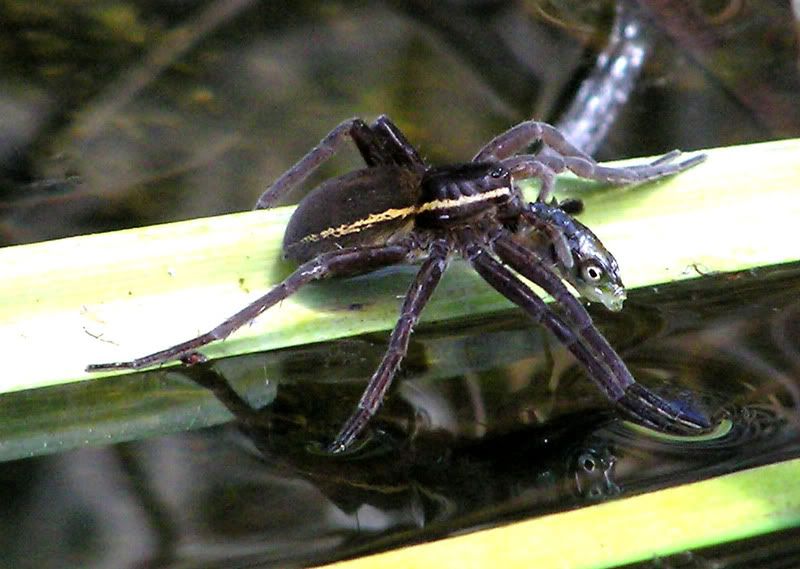
It’s been a while since an arachnid has graced this blog, and since I only have three arachnid posts total, it’s high time I add to it1. Everyone keeps calling it “one of Europe's largest, most beautiful but least common species of spider.” Hate to break it to you guys, but it’s still a spider, and most people don’t like spiders.

Image by Helen Smith
Yeah, I think it’s pretty too. But look how surprised that fish is!

The Fen Raft Spider (Dolomedes plantarius) is not an aquatic spider--there’s no such creature2. However, they aren’t aquatic in the same way a Water Strider isn’t aquatic. Just because you can’t swim doesn’t mean you have to get out of the pool—or rather, off the pool. They skate on top, using surface tension to float across the bogs and swamps; hence the name “Fen Raft”.

These spiders are found throughout in wetlands throughout Europe, with a fairly spotty distribution. They do not build webs to hunt, preferring to wait on a stem with their front legs touching the water’s surface. When they feel a vibration, BAM! Dinner is served. Main courses typically include aquatic insects, water striders, and less frequently, fish, like our surprised friend shown above.

The water also comes in handy when a male Fen Raft Spider wants to woo the ladies. Courtship involves drumming the water until the couple meets, when they both begin to bob slowly to each other. Mating is quick, likely because it is not unheard of for the male to become a protein source. After laying the eggs, the female carries the egg sac under her fangs for about three weeks. After hatching, the young spend a week growing up in a web-nest that’s constructed and guarded by mom.

It seems that wetlands are disappearing everywhere, and therefore, so are the Fen Raft Spiders. The remaining wetlands are getting more and more pollution problems, and all evidence suggests that these spiders require clean water. There’s certainly hope though. Britain has pulled out all the stops trying to protect their two populations from dying out, and frankly, it seems to be working.

1Here’s a challenge for you readers: can somebody find me an endangered whipscorpion? That would be cool.
2These are not spiders.

Sunday, January 27, 2008

Meet Ya Down at the Crawdad Hole

I’ve got some exciting news that isn’t immediately related to the EUT of the week, but is still pretty cool. I got cited by Wikipedia! And, even more exciting, EDGE just put up a new Amphibians chapter… and I got cited by them! For the same post! Looking at my Sagalla Caecilian post, it’s not even particularly in-depth, but it’s somehow linkable by pretty big names. Excuse me while I go deflate my ego….

I found this week’s EUT a while ago, but somehow never got around to writing about it. Like a few other of my past posts, if you take a perfectly innocuous animal and make it huge, it slips right into the ugly category. On a side note, I’m surprised how few crustaceans I’ve written about so far.


Image from RamPumps.com
The Tasmanian Giant Freshwater Crayfish (Astacopsis gouldi) has enough modifiers in its common name that I don’t particularly need to explain its range, its habitat, or its superfamily. Its size could use some description, as it isn’t Giant Salamander or Giant Catfish giant, with a record of six and a half pounds and two and a half feet, it’s still a freakin’ big crayfish, not to mention the largest freshwater invertebrate.


I suppose I could also define its habitat more precisely, as they prefer clean, wooded rivers, and the juveniles are mostly found in headwater streams. Like most crayfish1, the Giant Crayfish is omnivorous, or, as this site states: “Their diet consists mainly of decaying wood, but they will also consume leaves, small fish, and rotting flesh.”


As a general rule, as a species gets larger, it takes longer to reach sexual maturity, and this is no exception. It takes males nine years and females fourteen years before they’re able to make little Giant Crayfish, and they can live up to 40 years. This, coupled with the completely unsurprising problem of overharvesting, has lead to their decline in numbers, and subsequent listing. The problem of habitat loss exists for the Giant Crayfish, just like it shows up for most headwater species.


Tasmania is doing commendably well in terms of conservation efforts. It has been illegal to collect a Giant Crayfish since 1995, and there have been habitat conservation programs and education programs running around the island in an attempt to save these cute little massive crayfish.

1I know, I know, not a fish. A lot of the Australian sources are calling it a lobster, and I suppose I could always resort to “crawdad,” but I’ve always called them crayfish, and never thought of them as fish.

Thursday, January 10, 2008

Babyface

When I started blogging, I told myself that I would have to keep a set deadline to make sure I kept it up. I would write one each weekend, and if I didn’t keep it up, I would almost certainly fall into the trap of procrastination. And here I am. I’m going to see if I can manage back into weekend-ly posts. Since this post is for last weekend, I’ll see if I can crank out another post by Sunday night. It’s getting harder than I expected to keep finding Endangered Ugly Things.
Image by Me


However, looking through IUCN’s list of amphibians, I never expected to see this guy. It’s the Axolotl (Ambystoma mexicanum), whose face appears on many “Strange Animals!”-type publications and programs1. They fall into that category due to the fact that they exhibit neoteny; that is, they never undergo metamorphoses like other amphibians, but retain their gills and dorsal fin for life. They are classified as mole salamanders (genus Ambystoma), which includes more everyday salamanders, such as the Eastern Tiger2.

If you think the name “Axolotl” is hard on the mouth, just wait, I’ve got a few doozies in the next paragraph.
The Axolotl likely gets its name from the Aztec words meaning “water-dog,” though some sources link it to the other Aztec god of the underworld, Xolotl, twin of Quetzalcoatl. With these clues (as well as the fact that its species name is mexicanum), it’s not hard to guess where these are generally found in the wild. Yes, it lives in central Mexico, and its historic range includes Lake Xochimilco and Lake Chalco, which hasn’t existed since before the Europeans showed up. Xochimilco (National Geographic pronunciation: SO-chee-MILL-koh) is now only a series of canals within the bounds of Mexico City. Understandably, Axolotl populations aren’t quite what they were when the Aztecs were using them as a daily meat source.

While pollution and habitat loss have thrown the wild Axolotls onto the Critically Endangered list, that isn’t to say that there aren’t many left. They breed in captivity wonderfully, and are used in many medical research labs to study their ability to regenerate limbs (wouldn’t that be convenient?).

The restoration of an ecological park has stabilized populations in the wild, and the introduction of the abundant captive bred individuals could bring these salamanders back from the brink. Also, a local university is working hard to save the local wildlife by increasing public awareness, and are using the Axolotl as their flagship species.

1I, personally, first came to know of their existence from a series called Zoobooks, where an Axolotl appeared on the cover of “Animal Wonders,” I believe.
2Neat fact: other Mole Salamander species have developed neoteny, which apparently frequently shows up where the water is low on predators and the surrounding land is dry.

Thursday, December 20, 2007

Catfish are Jumpin'

I know I’ve been way behind on my posts. My college has a schedule where the semesters are split into a twelve-week section, typically with three classes, and a three-week section, where one takes a single class and stuffs twelve weeks’ worth of information into it. So, the number of posts has suffered—in November due to finals, and in December due to heavy work load1. So, to make up for it, I’m going to see if I can put out two posts a week during Winter Break. First up, I present more evidence as to why Ugly Overload has an “Oversized Uglies” category.

Image from Fishbase

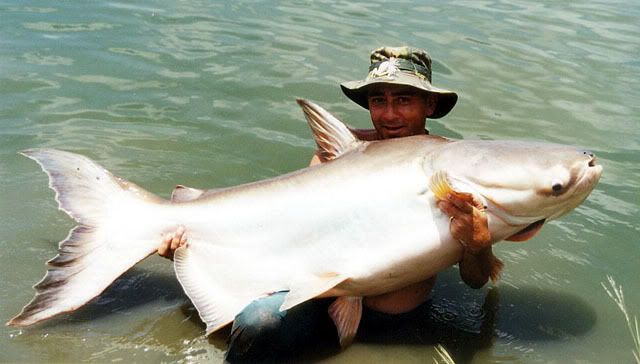
This is the Mekong Giant Catfish (Pangasianodon gigas), whose upper size limit is nine feet and 660 pounds, making it the world’s largest freshwater fish. They inhabit the Mekong River, the eleventh longest river in the world, which stretches through China, Thailand, Laos, Burma, Cambodia, and Vietnam. While the young have the whiskers that give catfish their name, those are lost as they age. I can’t seem to find a maximum age for these, but they can get quite old, considering the generation time is listed as 14 years.

The Giant Catfish is a grazer, eating the aquatic vegetation growing on the bottom of the river, though this source states that they’ll take “other food [read: meat] in captivity.” During the course of their lives, these massive fish will migrate up and down the river, from upstream breeding sites to downstream feeding sites.

As there is a lot of meat on a 600-pound catfish, it came to no surprise to me that one of the major causes of their decline is overfishing; even though that has mostly stopped, they’re still getting over it. Despite this, the Mekong Giant Catfish was moved from Endangered to Critically Endangered in 2003. The IUCN cites habitat loss and degradation—that is, damming and pollution—as the major causes.

Not all hope is lost. In an interview with National Geographic, one of the researchers says that there’s still a chance that these giants can make a comeback. They’ve been working on artificial spawning since 1985, and captive breeding since 2001. These, along with better pollution regulations, could bring the Mekong Giant Catfish back from the brink.

1I just wrote a ten-page paper on genitalia evolution. Look up the Argentine Lake Duck (Oxyura vittata), if you dare. Or, for that matter, Echidna reproduction.

Sunday, December 2, 2007

Up to My Neck in Trouble

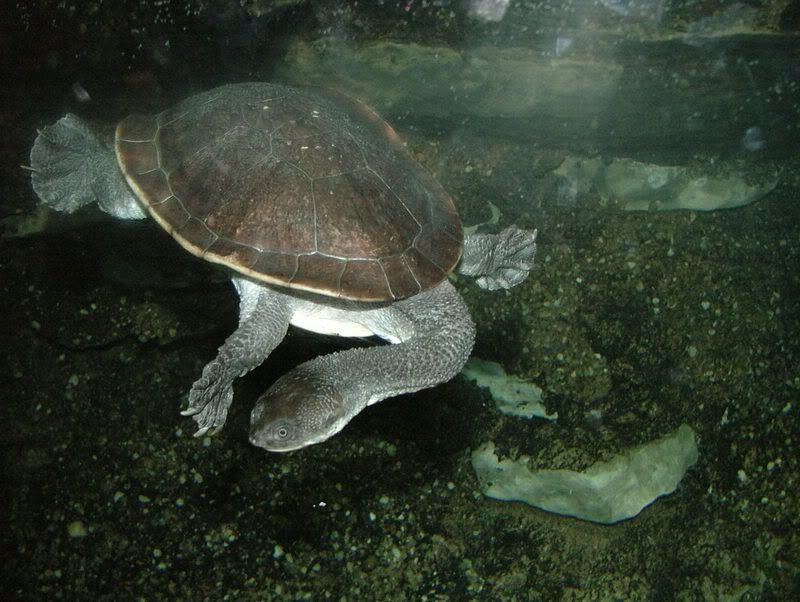
I have found that I can no longer visit zoos without specifically looking for EUTs. I suppose this isn’t a bad thing, as it’s always useful to expand my repertoire. On the other hand, it makes the experience slightly insufferable for people who come with me. Sorry. This time, it was again my home zoo, the Columbus Zoo and Aquarium. There were a few good turtles, but I had to choose one over the other. One had to fall by the wayside, because a) it is slightly cute (as evidenced by my girlfriend going “aww” upon seeing it), and b) the picture didn’t turn out nearly as well1.

Image by Me

The Roti Island Snake-Necked Turtle (Chelodina mccordi) is fairly aptly named. It is found on Roti Island, which is a 460 square mile Indonesian island, and it does, in fact, have a snake-like neck. There is even a video of this turtle on YouTube, taken at the Columbus Zoo. Like a number of EUTs before it, it’s creepier when it’s moving.

For some reason, I am having problems finding specific answers to why it has such an elongate neck. It is an opportunistic carnivore, and having a neck it can whip around is probably helpful in catching the quicker things, like small fish and tadpoles. Much like the Map Turtles and Red-Eared Sliders I’m used to, the Snake-Necked Turtle is semi-aquatic, so it typically spends most of its time in lakes, swamps, and rice paddies.

There are two major threats to the Snake-Neck’s survival. The first one is simply the fact that it has a small natural range, so there were fewer of them to begin with. The big issue, however, is the pet trade. Its sister species, the Eastern Snake-Necked Turtle (Chelodina longicollis) is one of the most frequently-kept turtle species in Australia, and the Roti Island Snake-Neck is paying for it. As demand increases, the most economic thing to do is to increase supply, and up the price. Roti Island Snake-Necked Turtles can fetch anywhere from $300 to $500 on the black market.

This is exactly the sort of thing that CITES was created for. Now, any international trade of this turtle requires the right permits. It’s also been upgraded (downgraded?) to Critically Endangered on the IUCN red list. Other conservation programs have taken an interest, and there are breeding programs set up, though some confusions with similar species2 has slowed down the process some.

1For those who are curious, it was the Fly River Turtle (Carettochelys insculpta), which is neat because it’s a freshwater turtle that looks like a sea turtle.
2As infallible as we’d like to think we are, biologists don’t always get it right.

Monday, October 22, 2007

Blacksnake

Image from FWS In April, I mentioned an Ohio endangered species that got some cable airtime, and rightfully so. Mike Rowe from Dirty Jobs1 traveled to Ohio’s north coast (that is, Lake Erie) to spend some quality time with someone I am proud to say that I (very briefly) worked with.

The Lake Erie Water Snake (Nerodia sipedon insularum) is, like most water snakes, very angry. They’re not venomous or dangerous in any way, just large and inclined to bite and musk. How large, you ask? They can get up to 3.5 feet. This “musking” is a defensive mechanism in which they spray the smelly contents of their cloaca3 all over whomever has grabbed them. It’s not pleasant.

They make their home on Kelley’s Island, a small (8 square miles) island just 3 miles off the coast of “Mainland” Ohio. I suppose that’s inaccurate, as that may be their geographic location, but they really make their homes squeezed among boulders of the rocky coast. From there, it is a short slither into the lake for some fishing. Water Snakes live up to their name well, as they are agile hunters in the water, and eat their share of small fish, frogs, and other similarly sized aquatic wildlife. They may be the same species as the common Northern Water Snake (Nerodia sipedon sipedon), but as a separate population, they are entitled to their own protection.

As Kelly’s Island is a popular resort town, the snakes were not exactly the most welcomed of natives. For years, they were tormented by locals and visitors until, in 1999, there were less than 2,000 left. In May 2000, they were added to the Ohio and Federal Endangered Species Lists, and signs declaring “Save Our Snakes” were distributed through the island. Kristen Stanford, in an effort to change public thought surrounding these snakes, has become the Island Snake Lady, and the Lake Erie Water Snake population is now up to a minimum estimate of 6,500 individuals—not bad for seven years. The way she reaches the public is by reaching the children. At one herpetological meeting, she talked about a grandmother who wouldn’t harm the snakes any more because little Jimmy (name changed to protect the innocent) had talked with the Snake Lady, and the Snake Lady said the snakes were good.

Anybody who lives around the Great Lakes knows that the invasive Zebra Mussels have become an ecological nightmare. Well, not long after they were introduced, a natural predator of theirs, the Round Goby, was also (accidentally) brought into the lakes. This didn’t particularly lower Zebra Mussel populations, and Round Gobies boomed. However, the Lake Erie Water Snake seems to feed increasingly on these alien invaders. If the Gobies eat the Mussels, and the Water Snakes eat the Gobies, we might be one step closer to solving that problem.

1One of my dreams is to have a research job so disgusting that it can be featured on a show like that2.
2Another is to host a show like that.
3Latin for “sewer”. You can probably guess what it is.

Monday, October 15, 2007

Dragonfly1

As an adult, this week’s EUT is a dazzling green aerobat, a thing to behold as it zips through the air, decreasing the mosquito population. As a youngster, it is a brown, hairy spider-like thing that lurks at the bottom of wetlands. It uses a projectile jaw to snatch at unsuspecting prey that swims by, as if something from Alien. It is still ultimately helping with the mosquito population.
Image from University of Michigan


The Hine’s Emerald Dragonfly (Somatochlora hineana), like all dragonflies (and damselflies, for that matter), are always found near water habitats. Not only are these prime habitats for the flying insects that make up their prey, they provide a good place to raise the kids, who are entirely aquatic. The Hine’s Dragonfly website2 mentions that mosquitoes and deerflies3 make up a large amount of the adult’s diet. Since the larvae of both of those are aquatic, you can believe that the Dragonfly larvae eat them. Once they get big enough, the Dragonfly larvae might even go for some small fish. The projectile jaw can be seen in action in this short video, though I can tell you it’s not a Hine’s Emerald. The jaw works the same, though.

The reason that I have no issue posting about these flitting jewels is that, for all intents and purposes, the adults aren’t in danger. The larvae, however, have problems as the wetlands are continually polluted by runoff and pesticides, filled in, and drained. They used to be found in Ohio, Indiana, Michigan, Illinois, and Wisconsin and Missouri. They haven’t been seen in Ohio and Indiana since 1961.

The recovery plan for the Hine’s Emerald Dragonfly mostly involves protecting the wetlands in which they’re already found. Many places are more and more worried about the states of their wetlands, since they’re discovering the ecological role that these habitats play. I know Ohio has its Rapid Assessment Methods for wetlands to designate and classify the state of wetlands. In the “Why Wetlands Are Important” Section of this site, it says that: “They are often referred to as ‘nature’s kidneys’…” This is an accurate, if slightly disgusting metaphor, since they filter out all the disgusting chemicals that flow through “nature’s veins.” Just remember, if you throw too much crap into the kidneys, they die, taking the rest of the body with them. “Nature’s dialysis machine” would not look pretty.

Edit: This is completely off topic, but I just found the blog of the people searching for the Attenborough's Echidna, which I wrote about a few months ago. It looks like they're getting close to finding it, too!

1There are about 12 songs called "Dragonfly." Pick one to use for this title.
2To quote directly: “The ugly larvae have been called little "dirt balls" since dirt clings to the hairs that cover their bodies.”
3Let me tell you, when, while doing stream studies, the desire to do terrible things to deerfly larvae is overwhelming.