Showing posts with label Mammals. Show all posts

Sunday, October 14, 2012

I Only Have Ears For You

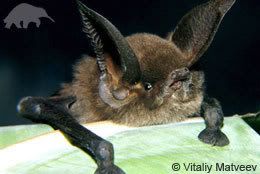
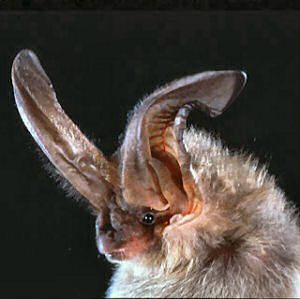
I promised myself I wouldn’t post a mammal unless it was certainly ugly. I have come to the realization that, y’know, I’m a pretty bad judge of ugly. Bats with noses like satellite dishes are just par for the course. So, here’s a bat with ears about half as long as its entire body and facial glands on either side of its nose.

Image from Bat Conservation International

Those glands on the Virginia Big-Eared Bat (Corynorhinus townsendii virginianus) probably emit pheromones. Nothing quite like natural perfume sacs right next to your nose (it’s amazingly difficult to definitely determine this sort of thing). Like many other bats, they are nocturnal insectivores, feeding mostly on moths. Unlike most bats, they’re late sleepers1, as they leave the cave about an hour after dark instead of an hour before. Since they fly fairly slowly, they’ve got their share of predators, including barn owls, and the less native feral housecat.

Big-eared bats mate in the fall and early winter. Since bats in temperate habitats tend to hibernate all winter, this might not seem like a good idea. But fear not, dear reader, for the female big-ear has a trick up her… sleeve. She is able to keep the sperm through the winter, ovulate in the spring, and have the baby (well, pup, actually) in early summer, when all the juiciest moths are out and getting in people’s campsites.

Not only are the big-ears late sleepers, they're also light sleepers in the winter. When the bats are hibernating, disturbances cause them to wake up, shift around, and lose valuable energy for managing their way through the winter2. Thus, spelunking and other caving activities are potentially dangerous to these bats. Intrusions during other times of the year can directly affect young, or drive the bats to look for a new home.

To keep these occurrences at a minimum, gates or fences have been placed around the colonies by concerned government employees. Studies on big-ears’ favorite roosting places are being conducted to see what else we can do to study them. And, on the political front, in 2005, the Virginia Big-Eared Bat was chosen to honorably represent the Commonwealth of Virginia as the Official State Bat.

1Like many college students.
2Also like many college students.

Friday, December 9, 2011

They Call Him Flipper

Dolphins are charismatic, no question about that. They play, they learn, they do amazing acrobatics. Their smiling faces draw people to aquatic parks worldwide. The freshwater dolphins have gotten some press lately, but they aren’t the prettiest dolphins around.


I suppose the Gharial-like snout on the Ganges River Dolphin (Platanista gangetica) is what bothers me about it. Its stubby dorsal fin gives it a humpbacked appearance that is far less pleasing than the torpedo-shaped marine dolphins we’re used to. However, both of these serve an important purpose: maneuverability. The shorter dorsal fin allows for faster turns, and the thin, tooth-filled rostrum is perfect for slashing sideways into an unsuspecting fish.

The Ganges River Dolphin is also effectively blind. The lack of a lens means that any light entering the eye is only seen as unfocused blurs of shadow. However, for a creature with echolocation living in the silt-filled rivers of India, this is less of a problem than one would expect.

As those silt-filled rivers are in some of the most densely human populated areas of the world, you can expect there to be some environmental issues. Damming, pollution, boat traffic, and by-catch are all problems that this blind dolphin faces. The Yangtze River Dolphin faced similar problems, and is now listed as “functionally extinct”.

The Ganges River Dolphin may have some support to save it from that fate. Dolphin reserves are being established, and the WWF is trying its darndest to educate the public. India even named this dolphin the National Aquatic Animal. However, there is still a lot of work to be done to make sure it doesn’t go the way of the Yangtze River Dolphin.

Monday, May 23, 2011

He Put the Taz in Taz-Mania

Image from Tasmanian Parks and Wildlife Service
Much like the Hyena and the Wolverine, the Tasmanian Devil (Sarcophilus harrisii) has a reputation. Once again, that reputation as a fierce predator and unscrupulous scavenger is not entirely unfounded. As the largest marsupial predator alive, the Tasmanian Devil will kill and eat most anything smaller than itself, and happily scavenge the remains of anything larger. The name “Devil" seems harsh for an animal the size of a lapdog, but when early settlers heard them fighting through the night, “Devil” came readily to mind.

Tasmanian Devils don’t typically hang out together except when a particularly large carcass has been found. Disagreements soon break out1 about who gets to eat first. However, like its Warner Brothers counterpart, the Tasmanian Devil is more loudmouth than fighter, especially to its own species2. There is a lot of growling, and baring teeth, and even some nipping, but physical fights are rare.

The home life of the Tasmanian Devil is nearly as dysfunctional (by human standards) as its table manners. When a female is ready to mate, she will visit a number of males to make sure she’s pregnant. She will give birth to about 30 raisin-sized babies, which is an issue, because she only has four teats. The newborns race to the pouch, and only the winners survive to weaning. In eight months, the young are ready to head out on their own.

Since European settlers arrived in Tasmania, the Devils have had a roller-coaster ride in terms of population. Initially they were killed for raiding chicken coops and the like. In the 1940s, they became protected by law. This increased their numbers enough that they were once again considered a pest species by the 1980s. Then, in the 1990s, a new threat emerged: Devil Facial Tumor Disease. This is a contagious cancer that has once again reduced Tasmanian Devil population to a fraction of what it once was.

The Tasmanian government has lost no time in trying to protect these animals, including quickly having the Tasmanian Devil listed as endangered. Breeding programs, disease research, and awareness campaigns have popped up all over the island in an attempt to save this little loudmouth.

1 While the Tasmanian Devil in that video is eating, he sounds exactly like my cat.
2For your listening pleasure, please compare Mel Blanc’s interpretation with the real thing. I’m sure your co-workers won’t mind if you’re listening at work.

Tuesday, July 27, 2010

Black and White and Red All Over

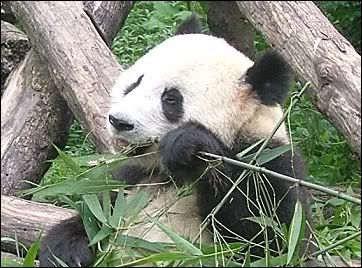
This marks the 100th post on this blog. To celebrate, I intend to do something a little different from what I’ve done in the past. For this month’s species, I’ll be writing about an animal widely considered to be one of the cutest around. It has become China’s golden child and the face of the World Wildlife fund. I am, of course, talking about the Giant Panda (Ailuropoda melanoleuca). While previously thought to be halfway between bears and raccoons, recent evidence puts them squarely in the bear family. Keep that in mind as you read this, as there is a depth to these animals that isn’t widely publicized.


The idea that Pandas eat only bamboo isn’t too far from the truth, as it makes up the large majority of their diet1. However, they are not above enjoying carrion if they happen to come across it. This is beautifully illustrated in this ARKive video, where a Panda saunters up to a rotting deer carcass, rips off a leg, and sits back to enjoy his meal. There are even reports of a wild Panda killing sheep, though it didn’t eat any of them.

Carnivory is one thing, but surely aggression isn’t a trait of these cute fuzzy-wuzzys, right? I’m sure that’s what went through mind of the drunk man who jumped into a zoo enclosure to give Gu Gu the Panda a hug, right before Gu Gu bit his legs. Or the teenager that scared Gu Gu into biting his legs. Or the man who jumped into Gu Gu’s enclosure to retrieve his 5-year old’s toy. Guess what happened to him. “Not so Cute” or “Not too Cuddly” seems to be the response of reporters on incidents like these. How surprised would we be if these had occurred with a Grizzly Bear? This is just an increasingly frustrated animal trying to defend its territory. The story is likely the same for the Panda in this video, attacking a man sitting outside its enclosure.

While it may seem like I’m trying to vilify the Panda, it's only to prove a point. I’ve got nothing against scavengers, or even dangerous animals. But the Giant Panda just dropped a few levels in the cuteness scale in the last two paragraphs, didn’t it? I’ve got all sorts of tidbits that could make any Charismatic Megafauna seem less charismatic2. Putting an animal on a pedestal just makes it that much easier to knock off, and turning an animal into a symbol makes you forget that it’s an animal. All creatures have behaviors that humans aren’t fond of, but we can’t expect them to act like giant teddy bears. While conservation efforts have helped the Giant Panda in the wild, over-exposure of the “cute” version of their life has left more and more people bored by its plight. The solution, as I see it, is to spread the exposure around to any other species that could use the help. Which is where I come in, I suppose. I hope I’ve managed to achieve that since I started this blog.

I really want to thank all of my readers who have stuck with me through these one hundred posts. I also have to thank my fiancée and my parents, who have helped with editing and ideas, but far more importantly have completely and utterly supported this fool idea of mine for four years. Thank you.

1 All bears are omnivorous, but the meat to veggie ratio depends mostly on the availability of the food.
2For example,
Gorillas and Lions will commonly kill the young of competing males. Chimpanzees and Dolphins commit murder of their own species. Black Rhinoceroses have the highest rates of death from fighting each other than any other animal. I could go on.

Wednesday, June 30, 2010

Night on Bald Mountain

My fiancée has had a deep-seated dislike of non-human primates for a long time. So when she told me to look at this ugly monkey she saw on the ARKive front page, I was doubtful of its ugliness. I was wrong. It looks like the gremlins from, well, Gremlins (Use this picture for comparison).

Image by Dominic Wormell


The Brazilian Bare-Faced Tamarin, or Pied Tamarin (Saguinus bicolor), is unsurprisingly found in the Amazon basin in Brazil. Like most tamarins, it spends its time avoiding predators and eating fruits, tree sap, and small animals. They live in small groups, with between four and fifteen individuals.

Their group structure is a reverse harem—the alpha female gets to mate with whatever male she likes. Most tamarins give birth to twins, and the Pied Tamarin is no different. Dad takes care of most of the child rearing (other than nursing, of course), with the other subordinates helping out. The whole group sleeps in one big pile, which I’m sure would be adorable if their faces didn’t look like gargoyles’.

There is one main unanswered question I have about the Bare-Faced Tamarin—why is it bare-faced? What purpose does a hairless face serve? It’s not like these guys bury their head in carcasses, like storks and vultures. My guess, which is only a guess, is that it may have something to do with keeping their head free of parasites. The problem with this theory is that they groom each other, meaning that other members of their group should be able to help with the nit picking.

As far as their status is concerned, the Pied Tamarin isn’t doing so well. They are considered one of the most endangered Amazonian primates due to their small, fragmented range coupled with the constant rainforest destruction we’ve all been hearing about for the last decade. Primate conservation programs, as well as captive breeding programs are working on keeping this goblin-faced monkey around.

Sunday, April 25, 2010

Groundhog Day

Greg, also from Not Extinct Yet, suggested that I write about the Blobfish. I really wanted to write about the Blobfish. If there’s any animal that could use a space on this blog, it’s the Blobfish. There’s really not enough information out there about it to get a full post out, though. My fiancée has been (strongly) suggesting a different animal since the Olympics in February. It’s somewhat cute, but in the end, it’s just a big Groundhog.

Image from Simply Wild CanadaThe Vancouver Island Marmot (Marmota vancouverensis —that’s a Road Runner & Coyote scientific name if I ever heard one) has been cut off from the rest of the mainland Marmots since the end of the last ice age 10,000 years ago. Like many rodents, these Marmots hibernate during the winter. Unlike most rodents, that hibernation lasts eight months. Even during those brief summer months, they spend most of their time in the burrows, coming out only to feed, lounge on rocks, and goof off.

Being a rodent of smallish stature (the standardized size comparison seems to be "a large house cat") predation is a fact of life for the Vancouver Island Marmot. Cougars, Wolves, and Golden Eagles all find the Marmot to be a tasty treat—no wonder it spends most of its life underground. Also being rodents, they have a high reproduction rate, where babies made in May are out of the burrow by July. A single female can produce about 15 young in her life.

This high reproduction rate may save the species. Man-made habitat changes decreased their naturally low population numbers almost to the point of genetic collapse. It was estimated that there were 21 wild Marmots in 2003, the rest (75 or so) in breeding programs in zoos and conservation centres. That breeding program has been remarkably successful, as they have released a total of 223 Marmots since then. Yes, some of them have fallen victim to predation and other natural deaths, but the wild population is up to about 120 now, and the captive population is steadily growing.

Monday, December 28, 2009

Hail to the Victors Valiant

I apologize for the unintentional two-month hiatus. Thanksgiving, leading right up to finals left me little time to search for Endangered Ugly Things. Next semester, I am only doing thesis work and teaching the Invertebrate Zoology lab, so hopefully I’ll be able to get back to my regular update schedule. This specific animal had to wait until after the regular college football season, to not upset my relatives who are Ohio State University alumni.

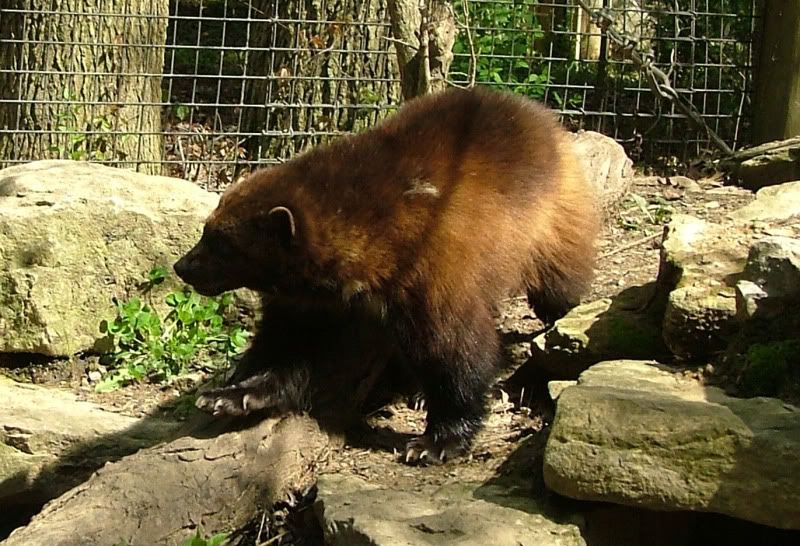
Image by Me


The Wolverine (Gulo gulo) is, for all intents and purposes, a very big weasel. Forty-five pounds big. They are found around the world, under the Arctic Circle. Due to the large amount of food each individual requires, they have massive home ranges, with males wandering around an area of nearly 250 square miles. They can take down large prey (up to Caribou), but tend to scavenge when they have the opportunity.

The Wolverine has gained the same sort of reputation in North America as the Hyena does in Africa—a mangy, dangerous, scavenger (my dad has other names for the University of Michigan Wolverines). They aren’t mangy, but they are mainly scavengers—why fight a moose when it’ll die of starvation soon enough? They can also be quite dangerous, but name a fifty-pound animal that isn’t1.

I suppose what really irks me is the instant inclusion of scavengers into the “evil” category. Wolverines, hyenas, ravens and vultures all tend to get thrown into this role. I suppose this trend comes from the association with death, but I tend to see them more as janitors. They serve a vital role in cleaning up the ecosystem (would you like to be neck deep in deer carcasses?), and they get absolutely no respect for it. As the mutant Logan states "I'm the best there is at what I do, but what I do isn't very nice."

Despite their ferocious image, the mothers take good care of their young, keeping them close and safe for more than a year after they are born. It’s at this stage of life that Wolverines are the most vulnerable to other predators in the area, but when there’s a protective mother Wolverine in the area, that’s not all that vulnerable. Videos of the baby Wolverines are just as cute as you’d expect baby mammals playing to be.

Despite declining numbers due to the expanding range of humans, predator poisoning regimes, and trapping, Wolverines are not listed by the IUCN. They’re not even federally listed in the US (despite multiple petitions for such), due to lack of data on their numbers, though there may be some pressure from groups who still want to trap these animals. They are, however, listed as endangered in Canada. As information grows about these animals, hopefully we can begin to better protect this ferocious (sometimes) scavenger.

1Dad mentioned the Capybara. Wikipedia says they “…are gentle and will usually allow humans to pet and hand-feed them.” Dang. Alright, smart guy, name a second one.

Thursday, October 30, 2008

Be Prepared

Many of my readers may know that the Spotted (or Laughing) Hyenas’ (Crocuta crocuta) reputation for being scavengers is undeserved; they hunt at least as frequently as Lions. A smaller subset probably knows about the… um… interesting morphology found in female Spotted Hyenas. I hate to disappoint, but the Hyena I’m writing about today has neither of those characteristics. Meet the Brown Hyena (Hyaena brunnea).
Image from Lioncrusher's Domain


It is much scragglier than its spotted relative, as well as being smaller. Their main food source is dead things, which they find using their acute sense of smell. While most of their diet is made up of carrion, this doesn’t mean they don’t hunt. Do you want to see a moderately ugly animal become instantly vilified? Watch this video of a Hyena on the coast hunting a baby Fur Seal. Of course, there’s no reason for the vilification—the Hyena’s gotta eat.

While they hunt and eat on their own, they come home to clans made of three to five other family members. Females will mate with unrelated nomadic males—just passing through—to prevent inbreeding. Cubs are raised by the whole family, and females will (begrudgingly) suckle others’ young. When the babies are on solids, the clan will bring back food for them.

They live in southern Africa, south of the Spotted Hyenas’ range. They prefer semi-arid environments, though some live on the Namibian Coast1. They can survive close to urban areas, which is what gets them in trouble. People will find them feeding on dead livestock, and assume the Hyena was the killer. ARKive states: "The brown hyena is a poor hunter, but will often make feeble, frequently unsuccessful, attempts to catch any small animal it encounters." Does that really sound like something that would take down a thousand-pound cow? This kind of persecution lead to the Brown Hyena being listed as Vulnerable by the IUCN.

It's not listed as Vulnerable anymore. Education programs have lead to farmers reconsidering their views on Hyenas. That, coupled with the maintanance of large conservation areas have helped the Brown Hyena back from Vulnerable; it is now listed as Near Threatened. If this continues, it might end up as another "Conservation Success Story," like the Bald Eagle and Lake Sturgeon.

1One would assume that those are the ones catching the Fur Seals, unless the baby was really lost, and meandered 500 miles inland.

Tuesday, March 25, 2008

You Dirty Rat

Today, I had an urge to write about a non-descript rat thing. At one point, I mentioned that the EDGE website was full of them. So, I went trolling, but to no avail. Many of them are quite cute. The ones that aren’t, well, it’s possible that some of them have been extinct since the ‘60s and no one’s noticed1. Then, like a bolt from the blue, I remembered a non-descript rat thing that was much closer to home. I mentioned it by name in the original essay, and promptly forgot about its existence.
Image from Pennsylvania DCNR


The Allegheny Woodrat (Neotoma magister) is literally a big packrat. Much like the Fen Raft Spider researchers who called it a “beautiful spider,” the Woodrat is described by Wikipedia as, “…particularly handsome in appearance resembling more of an over sized White-footed Mouse than the Norway Rat.” That’s not exactly a stunning endorsement.

As its name suggests, the Allegheny Woodrat is found along the Allegheny Mountains, typically in the woods. More specifically, these large rodents are found among rocky outcroppings, where they build their nests. They are nocturnal and understandably shy, as their main predators are owls, bobcats, weasels, foxes, and probably any other large predator that happens to be outside at that time of night. Their food consists of typical small herbivore fare: berries, seeds, nuts, and grasses.

Like other packrats, they make a bark-and-grass nest, tucked away in their little hidey-hole, and decorate it with exciting shiny things they find around the place. It has been suggested that they will place dried leaves near their football-sized nest to act as early warning systems to detect incoming predators. They raise three litters of three babies per year, which is apparently very few compared to their more promiscuous cousins.

Scientists have noticed the population decline of the Woodrats all over their range, except, apparently, in Kentucky, where they seem to be doing all right for some reason. Defoliation vectors, such as Gypsy Moth or Chestnut Blight have caused habitat problems throughout the Woodrat’s range. However, the best suspect for their decline is a little nematode known as Baylisascaris procyonis. As areas become more urbanized, generalists, such as Raccoons, become more populous. B. procyonis is a Raccoon parasite, and it is fatal to Woodrats. Most of the conservation efforts surrounding the Woodrat have been studies trying to control this parasite.

1I really don’t like the fact that I can’t write about some organisms because there’s not enough data out there. I may have to make a post of animals with cool names and insufficient data, just to keep track of them.

Monday, February 4, 2008

Or Would You Rather Be a Pig?

Well, I saw it was just about time for another mammal post, so I searched through ARKive’s list on the subject. I found something that I really thought was ugly. This may seem like a non-issue (it is Endangered Ugly Things), but I realized that I haven’t written about much recently that I consider ugly. I mean, I try to write about species that don’t tend to make the spotlight, but I like bats and snakes and salamanders. I guess I’m really just hyping this animal up, so here you go; judge for yourself.

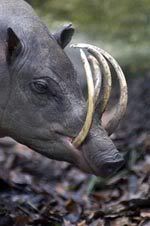
Image from Oregon Zoo

This is the Babirusa (Babyrousa sp.), a pig from Indonesia, whose name translates into “pig-deer.” Apparently, the… impressive dentition of the males look like antlers to some natives, but I don’t see it. While the picture may look like the top tusks grow through the snout, don’t let that fool you. They actually grow straight through the snout. While the males do fight fiercely for the females, the top tusks seem to serve only as ornamentation. While the natives claim that males can hang these tusks on branches to support their heads, other sources dispute this1.

Despite the formidable canines, these swine are herbivorous, even more so than many other Suidae. Since the tusks prevent searching for food by rooting, they rely on fruits, leaves, nuts, and the occasional insect larva. With this plant-heavy diet, they have developed a complex stomach, to the point that some people argued whether they were ruminants, and thus Kosher, or not2.

Unlike most other pigs, the Babirusa only give birth to about three babies a year, and are slow to reach sexual maturity. Add this to the facts that a) habitat loss, as forests are being cleared, and b) they’re a pig, and thus tasty, and you have the recipe for an animal listed as Vulnerable by the IUCN.

Conservation efforts are picking up, though. They’ve recently protected a large area of forest that the Babirusas inhabit, as well as increasing penalties for selling their meat. I even found an economic journal that states that, by their measurements, the penalties are enough to decrease poaching of these animals. Alas, captive breeding efforts aren’t going as well, as many of the Babirusas in American zoos are related, leading to definite genetic problems.

1I’m always cautious refuting native claims. They’ve lived with the animals for generations, so they’ve probably seen some strange things that the visiting scientists only dream of.
2To anyone reading my blog who keeps Kosher: They’ve decided that the Babirusa is treyf, so if you felt like traveling to Indonesia to eat an internationally protected pig, sorry.

Monday, November 5, 2007

Indiana Jones

There’s a species that I mentioned in the original essay that I haven’t written about yet. Its ugliness is questionable, but there are a lot of people who don’t like bats. I had hoped to get this up by Halloween, but various factors conspired against it.
Image from FWS


This is the Indiana Bat (Myotis sodalis), which, as its name suggests, is found in Indiana. About half of the entire world population roost there, with the rest of them spread out among the nineteen surrounding states. Their genus, Myotis, means “mouse-eared”, and includes more common species such as the Little Brown Bat, and three others that are found in Ohio1. The species name, sodalis, is Latin for “companion,” which is an appropriate name for them, as they roost in groups of at least one hundred individuals.

As far as shape and nightly habits go, the Indiana Bat is like most other small (they weigh up to 7.5 grams), insectivorous bat—hunting by echolocation, swooping after moths and mosquitoes all night, and coming back to roost at dawn. They make their roosts under sloughing bark of dead trees, typically near streams. In the winter, they find caves in which to hibernate. Their exacting standards for these hibernacula (the technical term) are one of the reasons that they are endangered. The caves must be between freezing and 50°F, and maintain about 95% humidity.

The National Fish and Wildlife Service states that one of the major threats to the Indiana Bat is human disturbances of their hibernating caves, much like the Virginia Long Eared Bat. However, even gating erected to keep people out can disturb the environment of the cave, if done improperly. Many people are also worried about their summer roosts being disturbed, or cut down.

There certainly are conservation programs in place to try to help them out. They are listed as endangered, federally and internationally. The major goal of the conservation programs is to prevent the disturbance of the nesting sites. In the Wayne National Forest, there is a single hibernaculum, but hardly a tree can be cut down without at least a few nights of monitoring for these furry fliers.

1And likely in nearby states as well. What can I say; I’ve lived in this state too long to not be a little biased.

Sunday, September 16, 2007

It's a Bird! It's a Plane! It's a Gliding Mammal!

Image from Colugos.com I don’t have any good quips for an introduction this week, but I’d like to let you know that this genus is much creepier in motion. Start this video at 5:31 to see it1.

The Philippine Colugo (Cynocephalus volans) is also known as the Philippine Flying Lemur. I won’t use that term again in this post for two major reasons: a) it doesn’t fly2, and b) it’s not a lemur. It is from the Philippines, so I can keep with that. They fit into the many, many gliding animals that are given the name “flying ___”3. There are only two species of Colugo, both in the genus Cynocephalus, which means “dog-headed,” which seems to be an accurate description. The Order, which is not too distantly related to the primates, is Dermoptera, which means “Skin Wing.” They’re not actually wings, but membranes that extend from the tips of their fingers to the ends of their toes.

Colugos spend their days in tree hollows. In the evenings, they dine on young leaves, which aren’t terribly nutritious (but more so than the older leaves), and run out on an individual tree fairly quickly. This is all right because, since they live in the Philippine jungles, fresh, new leaves are just a short glide (or not, they can glide for about 100 meters) away. Their hands and feet end in sharp claws for grasping onto trees, which is helpful if you never touch the ground in your life.

Young Colugos are born early and undeveloped, much like a marsupial. However, the mother lacks a pouch, so, instead, she folds up her tail and carries the young there until it can fend for itself. This means a mother can only have one, or at most, two, every few years.

Of course, a low birth rate means slow recovery from any threats that these animals face. The biggest threat, no surprise, is habitat loss. They don’t have a very large range, and the area is being developed fairly rapidly. Since they are wild herbivores, and like a good rubber tree leaf as much as anyone (probably more), plantation owners frequently regard them as pests, and deal with them accordingly. Habitat fragmentation is also causing a problem, as individual populations get cut off from one another, leading to less genetic diversity.

1If you’re interested in African Hunting Dogs, Indian Tigers, or the Amur Leopard, feel free to watch the rest of it.
2The difference between flying and gliding is simply the fact that fliers are able to increase velocity in midair, while gliders just fall really slowly.
3 Squirrels, snakes, “dragons”, squids, frogs, fish, and geckos, to name a few.

Tuesday, July 17, 2007

Echidna's Arf

Six months ago, Greg suggested a few animals which I could write about, all listed at the EDGE website. I’ve already written about two of them and I recently saw some news about the third one that suggests I should write about it. I wouldn’t call it ugly, but obviously someone would, since it’s named after the Mother of All Monsters in Greek mythology.

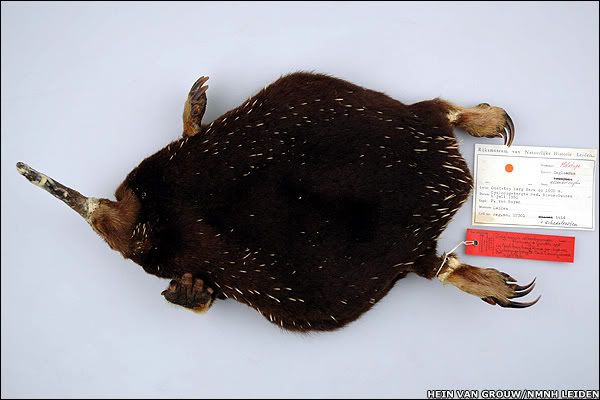
Image from BBC News

This is the Attenborough Long-beaked Echidna (Zaglossus attenboroughi). I suppose I should clarify that Sir David Attenborough is a famous TV naturalist and a co-founder of ARKive, not the Mother of All Monsters. That distinction belongs to Echidna. Actually, this is the only Attenborough Long-Beaked Echidna photograph. More on that later.

Long-Beaked Echidnas are insectivorous monotremes found on the island of Papua New Guinea. I’m not sure how much my readership knows about echidnas1, so I’ll give a basic description. Imagine a hedgehog with a long beak to help search for invertebrates, with a tongue like an anteater. Also, they lay eggs, which may seem strange. The term “monotreme” means “one hole,” which refers to their cloaca, as opposed to our… uh… two holes. There are three Long-Beaked species and one Short-Beaked Echidna.

While their smaller short-beaked cousins hunt for ants and termites, the Zaglossus2 forage for earthworms in the leaf litter. Echidnas are creatures of the night, and use their strong front claws to dig the burrows in which they sleep. Like the marsupials, they have a pouch, into which echidnas lay one egg. After hatching, the puggle3 laps milk which flows from patches, as monotremes have no teats. The young echidna is kicked out of the pouch, understandably, soon after the spines begin to develop.

The Long-Beaked Echidnas are endangered due to habitat loss and hunting for food. The reason the Attenborough Long-Beaked Echidna doesn’t look healthy in the photo is that it is the only specimen of the species, which was collected by a Dutch Botanist in 1961, and currently spends its time in a drawer in a museum in the Netherlands. Understandably, people thought it might be extinct. The good news is, new evidence suggests it might not be. In the area where they are found, the Cyclops4 Mountains, scientists have found “nose pokes,” which are holes made by the echidnas as they forage in the mud. Also, the locals say that they’ve been seeing them for about two years. The plan is to mount a full-scale expedition next year to find and photograph a live Attenborough Long-Beaked Echidna. If I’m still blogging by then, I’ll be sure to give you an update.

1I’m guessing quite a lot, but that doesn’t seem to stop me from explaining.
2Something to do with their tongues, right, Mike?
3Yes, this is the proper term for an infant monotreme.
4Alas, the Cyclopes are not among the monsters birthed by Echidna.

Wednesday, June 20, 2007

Secret Agent Bat

It’s been a bit since I’ve written about a mammal (actually, a month to the day) so I decided to raid the EDGE1 website, which deals with exceedingly endangered mammals, many of which are, unsurprisingly, small-rodent looking things, simply due to the large percentage of small-rodent looking mammals2 (those may come later). In this post, however, I’ll to tell you about a bat with the coolest adaptation ever: suction cups.

Image from EDGE

Yes, the Old World Sucker-Footed Bat (Myzopoda aurita) has, as its name suggests, suction cups on its wrists and ankles. Because of this adaptation, it can attach itself in cheesy-‘60s-spy-film style to the sides of broad leaves and smooth stems, hence the title of the post. Otherwise, it looks much like any other microchiropteran (echolocating bat, as opposed to the fruit bats), with ears bigger than its head and small, beady eyes. As my grandmother put it, it looks like a bulldog with fins.

There is little known about this bat’s specific habits. It is a moth-eater (mostly) and may require specific broad-leaved palms to roost upon. Researchers believe the glands in the suction cups might produce a glue-like substance (since we all know how long those plastic suction cups stick normally). While most bats are observed by mist netting, the Sucker-Footed Bat (such a cool name!) maneuvers well enough to avoid them, leading to even less certainty about this animal’s lifestyle.

They’re found only on the eastern edge of Madagascar, though evidence suggests it once (in the Pleistocene) inhabited most of eastern Africa. Loss of habitat has certainly negatively affected the bat’s populations, and sadly, there aren't many conservation efforts in place (although just telling you about it has helped the situation just a little bit). Scientists have recently found another species in the same genus, making it possibly a little less Evolutionarily Distinct.

Oh, by the way, the last suggestion I got was that post last month that I talked about. I’m kind of hard up for new ideas. Pleeeeaaase?

1That stands for Evolutionarily Distinct Globally Endangered, meaning that once these animals are extinct, nothing like them will exist in the world. Kinda chilling, isn’t it?
2Just because I’m describing them all as “small-rodent looking mammals” does not mean they’re all the same. Small-rodent looking mammals are exceedingly diverse.

Saturday, May 19, 2007

Golden Nosering

Two weeks ago, Phantom Midge1 threw a suggestion into the ring. I like the fact that when I complain about having been given no suggestions, there are always a few people who feel bad enough for me and find some. I’ll admit that this one isn’t horribly ugly, but once again, it’s the creepy, creepy nose.

Image from California Academy of Sciences


This is the Golden-Rumped Sengi (Rhynchocyon chrysopygus). “Sengi” is the new, fashionable term for elephant shrews, because elephant shrews are more closely related to elephants than shrews. All of the following (and proceeding) information I just found while looking up stuff on the Sengi2. Currently, taxonomists are having a field day with a wide variety of African mammals. It turns out that elephants, manatees, hyraxes, sengis, golden moles, tenrecs and the aardvark all are related to an ancient African mammal. Everything within is now grouped into the superorder Afrotheria, which, if I’m not too wrong with my Latin, means African Beast.

The Golden-Rumped Sengi is about nine inches long (bigger than I thought an elephant shrew was; that’s about the size of a full-grown Norway rat), with surprise, surprise, a yellowish orange patch on its rear. Under this patch is a thick dermal shield, which is used to protect against the biting attacks of other Sengis. They mate for life, living in monogamous pairs, and they jointly protect their territory. Males will chase off intruding males, and females will chase off intruding females.

The sengis use their long, flexible snout3 too seek and destroy insects and other yummy invertebrates that inhabit the leaf litter in the Kenyan forests in which they live. Being a small, and apparently tasty, mammal they’ve got to watch out for hawks and snakes. They escape by running up to 15 miles per hour, which is dang fast for something that small. After spotting such danger and sprinting away, they slap their tail on the ground as a warning. The predator then knows that it’s been spotted, so an ambush is out of the question.

Living, as they do in Kenya, habitat loss and fragmentation is the major issue facing the Golden-Rumped Sengi. In fact, their range is limited to two patches on the Kenyan coast; luckily (or more likely, because) those places are protected. Illegal hunting for food does happen, but ARKive says, “current levels are thought to be sustainable.” The California Academy of Sciences even says that it is possible to breed them in captivity.


1She really should get a blog, so I can link to her instead of her sister, who I’ve linked to enough that it’s easier just to put her on the sidebar.
2This blog is as much for my edification as anyone else’s. Heck, in just the last three weeks, I’ve learned to correctly pronounce “uakari,” what the thing on the top of a cassowary’s head is called, and of the existence of a blind wolf spider.
3You should really check out the ARKive videos on this. So creepy.

Sunday, May 13, 2007

The Monkey with the Red Face

Natalie1 suggested2 that I write about the White Uakari. The only problem was the species, the Bald Uakari, was listed as “near threatened” on the IUCN redlist. I’d like it to be at least “vulnerable” before I write about it. But then I looked at the page for the White Uakari subspecies, and, lo and behold, it’s vulnerable.
Image from World Wildlife Fund
Bald Uakari3 are a bunch of red-faced, cat-sized monkeys. I’ll get to the face later. The White Uakari (Cacajao calvus calvus) is the subspecies of which has a white coat. Other notable Uakaris are the red one, the Ucayli one, and Novae’s one, all of which are listed as vulnerable. I’m not quite sure how each subspecies can be vulnerable while the species is not, but IUCN said something about changing definitions of “vulnerable.”

Alright, back to the face. The deep Amazon of western Brazil, where the White Uakaris live, is a malaria hot-zone. Pale faces are a symptom of malaria. So, having a red face is the Uakari’s equivalent to a six-pack: I’m so exceedingly healthy, you just gotta mate with me. Redder faces get more mates, and the paler faces, well, get malaria.

The rest of the White Uakari is, well, white. It has a shortish (for a monkey), non-prehensile tail. They live in large troops, up to 100, though there are smaller subgroups within each troop. They are foragers, living mostly on fruits, with snacks of buds, leaves, and bugs. With the thickness of the Amazonian rainforest, they have little need to land on the ground, and spend most of their lives in the treetops.

Being a rainforest species, no one will be surprised when I tell you that their major concern is habitat loss. Human hunting also occurs, which certainly can’t help. Conservation, therefore, is still an issue. Though, as much as I harp on them, the WWF is doing their part to help. They alone are a major driving source behind rainforest protection.

1Who has linked to me for quite some time now, it’s only fair that she gets a link back.
2Phantom Midge, look out for a Sengi post soon.
3Which I just now learned is pronounced wuh-KAR-ee. I had been horribly mispronouncing it my entire life.

Sunday, March 25, 2007

Modest Mole

So the purpose of me writing is to talk about the endangered species that people normally wouldn’t want to save, right? Right; the issue is, I’ve noticed that there seem to be more comments on the fuzzier animals, or, failing that, the vertebrates. I suppose this is why the WWF generally focuses on marketing the saving of the pandas and tigers. Aren’t you here for the fruit flies and mosses? Apparently not. So here’s a fuzzy Endangered Ugly Thing, because I give the fans what they want. That, and I noticed I hadn’t talked about any marsupials yet.

Image from Give Us A Home


Marsupial Moles (genus Notoryctes, both species are endangered) are, in fact, very fuzzy, at least based on the pictures I’ve seen. The thing that disturbs me the most is that it looks like marsupial moles have no face. Their eyes have more or less atrophied1, the ears are small, hair covered slits, and their nose has grown a large horny shield. All of these adaptations help the Marsupial Mole burrow in the Australian desert where it lives.

Yes, it looks quite a bit like a “normal” mole (except that it has a flat nose). This is due to convergent evolution, since there were a good 130 million years since the last common ancestor. Since there were no burrowing insectivores on the continent, the Marsupial Mole took over the niche. It actively hunts beetles and ants, though ARKive has pictures of it devouring geckos,2.

The Marsupial Mole doesn’t live underground quite as exclusively as the placental mole, as their shallow tunnels collapse behind them and they surface frequently. Females will construct deeper permanent burrows to give birth. Their pouch (called, surprisingly enough, a marsupium) is situated so the opening is backwards, so sand doesn’t get in.

People aren’t quite sure why the Marsupial Mole is endangered. In the early 1900’s, aboriginals traded lots of Marsupial Mole pelts to the Europeans, but it’s been a while since then. The best guess now is predation by feral cats and other introduced placentals. Conservation efforts are just beginning, with the main goal to understand more about their ecology.

Edit: The "Save the Wartyback Mussel" T-shirt is now avaliable for Phantom Midge (and anyone else who wants one) to purchace here.

1Not really, that’s a very Lamarkian way of thinking of it. Eyes, which would just get sand in them and not be very helpful, were bred out of the population.
2Do these pictures not make it look like something out of Dune? It looks like the sort of thing to burst from the sand and just start eating people.

Sunday, February 25, 2007

Rudolph the Long-Nosed Antelope

A few weeks ago, Greg1 suggested some animals about which I could possibly write. I thank you profusely for your suggestions, and urge other people to send their ideas. I would never have thought to look at some endangered antelope to see if it was ugly.

Image from CITES


Yes, this is the Saiga Antelope2 (Saiga tatarica), which I mentioned in the footnote of the last post; it’s the one that looks like that informant from Star Wars3. They are more than just their big nose, but it’s big and ugly enough to make one ask: Why the nose?

It took a bit of searching to find an answer. ARKive states that the gigantic schnoz is used for warming the cold air of the winter, and for keeping the dust out in the dry summers. I don’t just have to take their word for it, since this article (which also has some rockin’-cool skull images) also mentions it (I think):

The enlarged nasal vestibule, lateral vestibular recess, repositioned basal fold, and septal cavernous mass are regarded as a coordinated adaptation to dusty habitats, such that nasal air flow can be dynamically regulated allowing for collection of inspired particulates in the vestibule and thus cleansing of air destined for the lungs.
Moving away from the nose (seriously, stop staring), the Saiga lives in Eastern Europe and Western Asia, wintering in the deserts and summering in the dry steppes, moving up to 70 miles per day during their migration north in April and south in November. Rutting happens at their wintering sites, where males gather up harems of females and fight fiercely for them. I’m sure many of you have heard that most animal fights are ritualistic and don’t end in death—most. The male mortality rate of the Saiga can reach 90%, much of that due to exhaustion. Those who survive start the trek back north to the steppes.

CITES has banned trade of Saiga parts, and hunting is banned in their range, but overgrazing, as domestic ungulates are introduced, is thought to be a major threat to the Saiga. The horns are considered aphrodisiacs, so poaching is rife. Under the Soviet Union, major controls were put in place that boosted its numbers, but since the collapse, poaching has come back into play. Sine only the males have horns, and have their own problems, this leads to a very female-heavy population, who don’t have enough males to inseminate them. The males are already dying from exhaustion; we shouldn’t add sexual exhaustion to the mix.

1See, if you suggest an animal, I'll link to you.
2The name is almost a misnomer. Taxonomists have argued whether these are antelopes or sheep. Current thought says that they’re an intermediate, halfway between the two.
3The first one, IV (not to be confused with the fourth one, I)

Sunday, February 4, 2007

Solenodon is Gonna Get You

An anonymous contributor from a previous blog suggested I take a look at the Cuban Solenodon. I did, and what I found was not pretty. Perfect. While I did just write about a mammal, I have to keep the viewers happy. That, and I don’t know where to look for my next post. Dear readers, please follow the example held by this nameless person, and give me suggestions for ugly things for me to relate to the world.


Image from Encyclopaedia Britannica
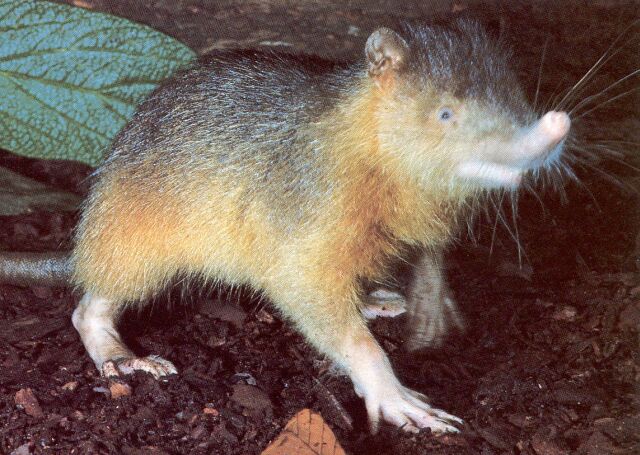
The Cuban Solenodon (Solenodon cubanus) is a shrew-like insectivore whose look reminds me most of a scaled down (to 6 or 7 inches) Rodent Of Unusual Size from The Princess Bride. They hail from the southeastern end of Cuba1, where they inhabit the dense, moist forests. They are nocturnal, relying on their sense of touch and their long snout to hunt.

They use toxic saliva to kill. Yes, the solenodon is a venomous mammal2, and its bite is used to subdue their prey—various arthropods. It is also used as defense against potential predators like snakes and birds of prey. Their name means “channel tooth,” which is likely the way to channel the venom, though I can’t find a source for that. Solenodons have an obviously positive impact on people, since their insectivorous habits help remove pests, and they are unlikely to hurt anyone unless you try to get bitten.

The solenodon is another island species that has been destroyed by the introduction of various carnivorous mammals. While rats, cats, and dogs have shown up in past posts, mongooses (mongeese?) have been introduced to Cuba, and destroyed the population. Enough that they were thought to be extinct, since none were found between 1890 and 1975.

Conservation is minimal, mostly relying on the fact that much of their habitat is within two Cuban National Parks.

1There also exists the Hispanolan solenodon, which is very similar to the Cuban variety, only on a different Caribbean Island. And cuter.
2I swore I had heard that the platypus, with a small spur, was the only venomous mammal. I was wrong.

Sunday, January 21, 2007

AYE Aye aye aye! (begin Crazy Train)

I’ve been mulling over this Endangered Ugly Thing since the inception of this blog. Is it cute or hideous1? Well, it was originally classified as a rodent, and the native Malagasy consider it a portent of death, so we welcome the world’s largest nocturnal lemur to Endangered Ugly Things.

Image from Duke University Lemur Center


The aye-aye (Daubentonia madagascariensis) has massive eyes and ears for better managing its nightlife. Like all lemurs2, they live in the dense jungles of Madagascar. Unlike the rest of the lemurs, their hands are long and spindly, with a skinny, elongated middle finger (I can’t find the average length, though). Aye-ayes tap the wood with this finger and listen for the correct echo with their huge ears, and gnaw a hole in the wood with their rat-like teeth before they begin rummaging for the grubs with their twiggy middle finger, filling much the same role as our woodpeckers. They will also eat fruit or vegetable material (or eggs), extracting the pulp using this finger3.

These raccoon-sized lemurs are usually solitary, moving along the treetops. Males’ home ranges are large (100-200 hectares) and encompass many females’ ranges. They tend to be curious and unafraid of people. Territories are marked by scents. When breeding season comes around, the females scream out to advertise their availability. The babies are weaned for about 7 months, and the females mate every three years.

Habitat destruction is the major threat to the aye-ayes, along with just about everything living in Madagascar. When agriculture invades their usual haunts, they will feed on the fruits, such as coconuts, becoming pests. Also, as mentioned in the beginning of the post, many Malagasy natives believe them to be omens of death, or other like portent, so they get killed on sight.

Many of the places aye-ayes live are protected, helping to save their habitat, and they are being introduced into other areas. There is a law against killing them, but it is not well enforced. Breeding programs exist at various zoos and the Duke University Lemur Center. But be warned, the little aye-ayes are even uglier.

1I get the feeling that the guys at Ugly Overload get this issue all the time.
2Which, appropriately enough, comes from the Latin “spirits of the night,” at least according to Wikipedia.
3ARKive has tons of wonderful pictures and videos, and it looks so much creepier when it’s moving.