Showing posts sorted by date for query sturgeon. Sort by relevance Show all posts

Monday, November 5, 2012

Like a Sturgeon

Last week, I showed my blog to my cousin, who just turned 20 (geez, we’re getting old). This was apparently a good move, since he sent me an e-mail earlier this week saying, “I think the lake sturgeon is endangered, but it’s kind of an older book.” A web search turns up threatened in New York, species of concern in Minnesota, and endangered in Ohio. And it’s plenty ugly, so good call there.

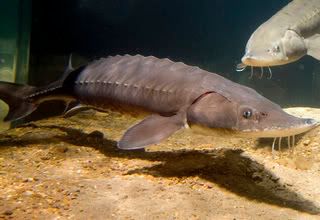
Image from Tennessee Aquarium

Think the 3-foot long lungfish with a 100-year lifespan isn’t enough? Howzabout the Lake Sturgeon (Acipenser fulvescens), right here in the Midwest, which, during its life of 150 years, can grow to 8 feet long. It has gigantic bony plates on its body, which grow smoother as it ages, because small spiky fish aren’t as digestible. The name “sturgeon” means “the stirrer” in various European languages (and, its scientific name means “reddish-yellow sturgeon” in Latin), which refers to its bottom-feeding habits. The “whiskers” (more technically barbules, which translates from Latin to… uh… whiskers) on their snout allow them to feel food items, such as crustaceans and small fish that are hiding under the substrate, which they suction up with their protruding mouth. Sound familiar?

As stated in the lungfish and tuatara posts, long life means one thing in the animal kingdom: slow to reproduce. Sturgeons take just as long to go through puberty as we do, reaching sexual maturity at 15 to 25 years of age, though they probably don’t have to worry about strange hair and cracking voices, what with being fish and all. Slow to reproduce means that this big fish is still getting over being used for meat, caviar, and isinglass (whatever that is). Pollution, damming, and the normal ol’ endangering factors still come into play.

Since this big bony fish has become protected in pretty much all of its range, the population has stabilized, even bumping it off the IUCN Redlist. It’s very much on its way to become one of those “Conservation Success Stories” like the bald eagle, but hopefully, when it’s pulled of the state endangered species lists, it gets some media attention too.

Thursday, October 30, 2008

Be Prepared

Many of my readers may know that the Spotted (or Laughing) Hyenas’ (Crocuta crocuta) reputation for being scavengers is undeserved; they hunt at least as frequently as Lions. A smaller subset probably knows about the… um… interesting morphology found in female Spotted Hyenas. I hate to disappoint, but the Hyena I’m writing about today has neither of those characteristics. Meet the Brown Hyena (Hyaena brunnea).
Image from Lioncrusher's Domain


It is much scragglier than its spotted relative, as well as being smaller. Their main food source is dead things, which they find using their acute sense of smell. While most of their diet is made up of carrion, this doesn’t mean they don’t hunt. Do you want to see a moderately ugly animal become instantly vilified? Watch this video of a Hyena on the coast hunting a baby Fur Seal. Of course, there’s no reason for the vilification—the Hyena’s gotta eat.

While they hunt and eat on their own, they come home to clans made of three to five other family members. Females will mate with unrelated nomadic males—just passing through—to prevent inbreeding. Cubs are raised by the whole family, and females will (begrudgingly) suckle others’ young. When the babies are on solids, the clan will bring back food for them.

They live in southern Africa, south of the Spotted Hyenas’ range. They prefer semi-arid environments, though some live on the Namibian Coast1. They can survive close to urban areas, which is what gets them in trouble. People will find them feeding on dead livestock, and assume the Hyena was the killer. ARKive states: "The brown hyena is a poor hunter, but will often make feeble, frequently unsuccessful, attempts to catch any small animal it encounters." Does that really sound like something that would take down a thousand-pound cow? This kind of persecution lead to the Brown Hyena being listed as Vulnerable by the IUCN.

It's not listed as Vulnerable anymore. Education programs have lead to farmers reconsidering their views on Hyenas. That, coupled with the maintanance of large conservation areas have helped the Brown Hyena back from Vulnerable; it is now listed as Near Threatened. If this continues, it might end up as another "Conservation Success Story," like the Bald Eagle and Lake Sturgeon.

1One would assume that those are the ones catching the Fur Seals, unless the baby was really lost, and meandered 500 miles inland.

Sunday, September 23, 2007

Hunchback of Colorado

It’s been a while since wrote about a fish, and I figured out I could search IUCN for all the Actinopterygii, that is, the ray-finned fish. Then found I could order the search by their category. While I found the pretty cool Shovelnose Sturgeon, there wasn’t enough information for me to write about1. The IUCN has recently highlighted the Humphead Parrotfish, which is ugly enough, but since they just highlighted it, I’ll let them talk about it.
Image from Desert Fishes


The Razorback Sucker (Xyrauchen texanus) is not too distantly related to the Blue Sucker that I wrote about a while ago. While it has a similar habit of eating organic detritus from the bottom of rivers, this one is lives in the Colorado River basin. It’s also larger, reaching lengths up to three feet, making it one of the biggest Suckers in North America. It has a big, sharp hump that gives it its name, which helps it navigate the fast moving rivers it calls home.

These Suckers are comparatively long lived, beginning to spawn at about 4 years old, and can live up to 40. However, despite their longevity, most of the young are dying early. This is mainly attributed to the large number of invasive predator fish that have been introduced into the Colorado River. Fragmented habitat and dams have also negatively affected their numbers. After all this, scientists estimate there are only about 500 adults left in the wild.

There are conservation efforts in place, many of which revolve around hatcheries in Utah and Colorado. The numbers are beginning to increase, and they’re certainly working on removing the invasive fish from the river.

1I’m getting pretty good at determining if I’ve got enough information fairly quickly anymore. A lot of that has to do with the number of photos Google has.

Monday, August 27, 2007

Crocodile Rock

Well, I was searching around IUCN’s redlist for a reptile to write about when I came across the legless skink (Barkudia insularis) which lives on an Indian island. Then, I find out that it had been recently rediscovered after not being seen for 86 years. It’s category on the redlist, however, is “Data Deficient.” While I know that these things need to be seen1, they don’t make for very long posts, and I’m getting tired of writing about things with limited information. Therefore, I hit the redlist again, searching for this beauty.
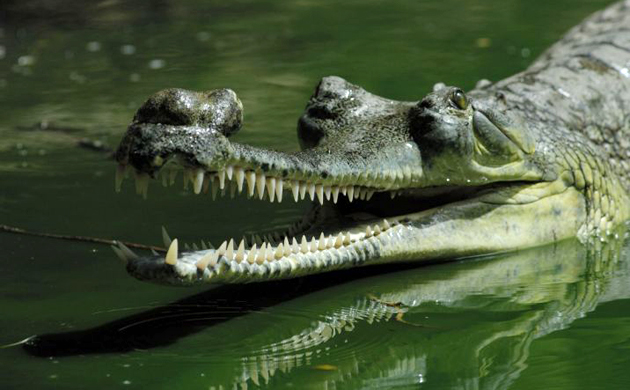
Image from The Guardian


The Gharial, or Gavial2 (Gavialis gangeticus) is amongst the largest crocodilians in the world, rivaled only by the Saltwater Crocodiles of Northern Australia. Gharials can reach up to about 21 feet and weigh approximately one ton. They inhabit fast moving rivers in the Indian subcontinent, where the purpose of the long, thin snout becomes apparent. While many crocodilians are ambush predators (think of the Animal Planet footage of one leaping out of the water for a wildebeest), Gharials rely mainly on fish for their diet. A thick snout like an alligators would produce large amounts of drag, but a long, thin snout can snap sideways, grabbing unsuspecting catfish.

Not that they eat only catfish, but birds, crabs, and small mammals are eaten if they can be caught. This website mentions that the people buried by Hindu funeral tradition in the Ganges river frequently end up in Gharial’s stomachs. By my thinking, this is a good thing, reminding us that, as much as we try to deny it, we’re still part of the food chain.

Gharials have a bit of their own success story, but not quite to the point of the Lake Sturgeon or the Bald Eagle. At one point, in the 1970s, there were about 70 of them left, due to poaching3, and habitat destruction as the population of India increases. Now, after lots of captive breeding and introduction, there are about 2,500 of them in the wild. This still isn’t a big population, but it’s certainly a start.

1Which is why I mentioned it here, even though it’s not what the post is about.
2I’ve always called them Gharials, so I have no clue why I searched for “Gavial”.
3Their snout is long, with a bulb on the end. Of course people thought it was an aphrodisiac.

Sunday, July 1, 2007

Paddlin' Madeline Home

Phantom Midge1 gave me a few good suggestions recently, but alas, neither the Yeti Crab nor the Zombie Worm are listed, whether or not they are actually in danger of becoming extinct. There are gobs of disgusting-looking deep-sea critters, but since so little is known about their populations and habits, there is not enough information for them to be placed on an endangered species list. There is, however, an aquatic animal that I had known about for a while, but about which I have neglected to write.
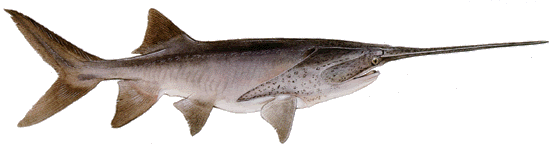
Image from Texas Parks and Wildlife
This is the American Paddlefish (Polyodon spathula), which I have seen for years at the Columbus Zoo, and was sure it was on the Ohio Endangered Species List. It wasn’t which slightly upset me, since I was planning on writing about it for most of the week. Turns out it’s listed as vulnerable on the IUCN redlist, so I get to write about it anyway. It lives in large rivers of the Mississippi River basin, growing up to a size of seven feet, and living up to about twenty or thirty years.

The protruding…thingy (actually called a rostrum) from which the Paddlefish gets its name is covered with electroreceptors to help it find groups of zooplankton on which it feeds. The minute prey are swept unceremoniously from the water by the gaping maw of the Paddlefish, and then filtered from the water by raking protrusions on the gills. The fish’s mouth is specifically designed to open to an immense size to filter the largest amount of water possible. Wikipedia suggests that the rostrum also acts as a hydrofoil to help keep the head level in the water as filter feeding occurs, but I don’t really like to cite them as a source.

The American Paddlefish live in rivers, so of course dams affect their populations by impeding their moving patterns. Much like the sturgeon, they have been harvested for meat, and their eggs have been harvested for caviar. Agricultural runoff causes the streams to silt up, making filter feeding a difficult prospect. To help relieve some of these threats, farm-raised Paddlefish are released into the wild. Stricter regulations on Paddlefish harvesting have also been put into effect.

1Still no blog, so here’s her sister’s link again.

Tuesday, June 12, 2007

Birdhouse in your Waldrapp

I had hoped that a trip to the Cleveland Zoo this last weekend with Miladyofthelake1 would prove fruitful, and, in fact, it did. Along with the Cinereous Vulture (near threatened—does that count?) and the Lappet-Faced Vulture (vulnerable), I found the Waldrapp Ibis (Geronticus eremita), which I think looks far more sinister than either of those adorably fuzzy carrion-eaters2.

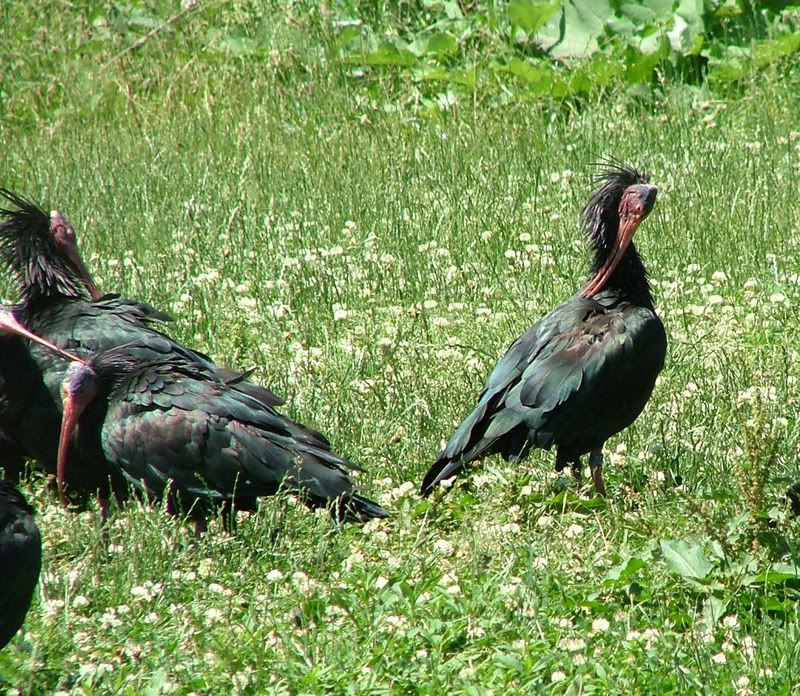
Image from Me

Yes, I said ibis, which most of you will associate with the American White Ibis or the Scarlet Ibis, which are much too bright and pretty. The Waldrapp Ibis (or Northern Bald Ibis, or Hermit Ibis) is oil-sheen black with a featherless head and a scraggly mane of black feathers that give it a buzzard look that no respectable shorebird should ever hope for. Not that the Waldrapp Ibis is really a shorebird, aside from being so phylogenetically. It lives in the grassy steppes of Morocco, Syria, and Turkey, as opposed to the marshes that its cousins inhabit. It still exhibits the same eating habits of other ibises by probing the mud (or dirt) for insects and lizards, and when the opportunity arises, small mammals. Completely shunning the aquatic lifestyle, they nest on cliff faces.

So why is it that these poor birds are critically endangered, and confined to three small areas, when it once roamed through all of Northern Africa, Central Europe, and the Middle East? It could be hunting, or nest site disturbances, or habitat loss. The insecticide DDT used in Turkey in the 1950s certainly didn’t help3, but they might be dying out due to natural causes. And these are suggestions from just one source. In other words, people do not know the exact reason why the Waldrapp Ibis is endangered.

Not that that’s stopping them from trying to help them out. Most zoos that house these ibises (and there are more of them in zoos than in the wild) are part of a Species Survival Plan, whose goal it is to breed animals in captivity to be released into the wild. Once there, the Waldrapp Ibis is protected by programs that are growing around them to see that they are undisturbed and happy.

1I have to thank her for editing most of the posts so graciously since, oh, about the lamprey post in late September. If you can read this without asking yourself, “What is he talking about?” thank her.
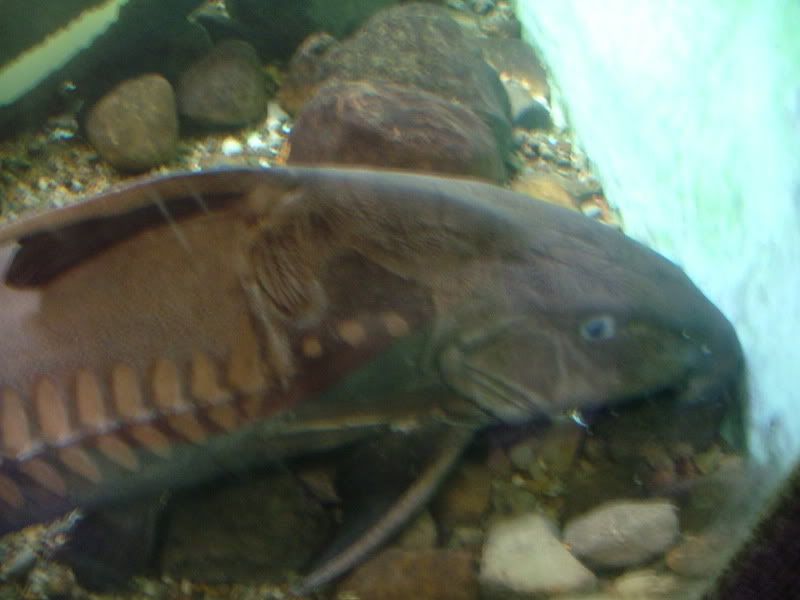
2I also found the Sturgeon Catfish, which is ugly enough to cause me to chastise myself for being disappointed that it’s not endangered. I have to keep reminding myself that I should not wish those sorts of things on an animal just so I can write about it.
3It has a tendency to wander up the food chain and kill whatever’s at top, cf. bald eagles in the United States.

Monday, April 23, 2007

I'm So Blue

I decided to look through the Ohio list to see if I could find anything of specific interest1. I realized that I hadn’t written about any fish for a while (though it seems I was on a bit of a fish-kick at the beginning). While in the fish section, I came across this blue sucker.

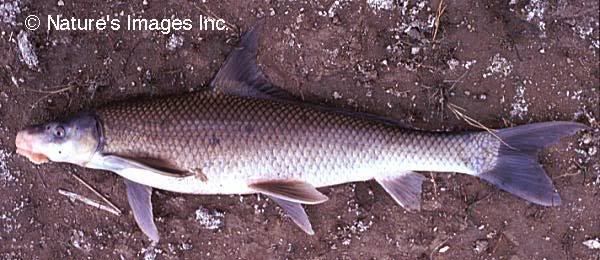
Image from Nature's Images Inc.


This is the Blue Sucker (Cycleptus elongatus), who populates fast moving streams in fast-moving Midwestern streams and rivers, mostly in the Mississippi river basin. Their mouth is the really disturbing bit: a pink, wart-covered maw used to suck up benthic aquatic invertebrates and some vegetative material. Their streamlined bodies (the elongatus part) and sickle-shaped dorsal fin help them manage their high-speed habitat. Spawning is fairly straightforward, occurring in spring and summer in deep rapids. The eggs are sticky, so they won’t immediately wash downstream.

It’s a freshwater species, so, like the Wartyback, the Lake Sturgeon, the Ohio Lamprey, the Eastern Hellbender, and the Queensland Lungfish, the Blue Sucker has a problem with dams2. In the sucker’s case, they’re built for fast-paced life, which is taken away by those concrete constructions3. Silt build-up is a by-product of dams that also isn’t too helpful, along with pollution draining into the rivers. Oh, and, they’re tasty, which is not a good thing for a fish trying to survive, as overfishing probably started the decline in the first place.

There’s good news for our azure friends: their numbers are increasing. Not, apparently, up to what they were pre-European, but they’re certainly on the rise. People who have never seen them before are reporting more and more. The reason given for this? The pollution levels are decreasing, and the Blue Suckers are finding alternative places to spawn. The fact that fishing them has been illegal since the ‘70s probably isn’t hurting.

1The Lake Erie Water Snake is on there, and I was considering writing about it, since it recently appeared on an episode of Dirty Jobs, along with someone I have worked with.
2Hydroelectric isn’t looking as good as it used to, is it?
3You’ve heard this one, but:
What did the fish say when it ran into the brick wall?
Dam.